
Quick Summary
Managing water damage repair costs requires evaluating water contamination levels, structural drying requirements, and complex urban building logistics rather than relying on generic online calculators. Floodline Restoration Co. demystifies restoration expenses through transparent, flat-scope pricing breakdowns and specialized in-place cavity drying that salvages structural materials to prevent costly rebuilds. Readers will understand how to document losses for successful insurance claims and can take action by requesting a free on-site visual inspection and written estimate from Floodline Restoration Co.
Water Damage Repair Costs: Save Money and Prevent Mold
Controlling water damage repair costs starts with how quickly you stop moisture from migrating into subfloors, ceiling assemblies, and framing. When pipes freeze or supply lines rupture, every hour of delay allows standing water to soak deeper into porous building materials. According to the Insurance Information Institute (III), water damage and freezing ranked as the second-most-common cause of homeowners insurance claims in 2023, with a frequency of 1.50 claims per 100 insured homes. While the average water claim severity that year came out to $15,400, final costs depend heavily on whether materials can be dried during mitigation or require structural repair, reconstruction, and replacement.[3]
As specialists at Floodline Restoration Co. note, for property owners across Long Island City and the greater New York area, standard online cost calculators rarely tell the whole story. Between multi-story riser layouts, freight elevator scheduling, and historic brick or timber construction, urban restoration requires clear scopes of work rather than open-ended estimates.
Key Drivers of Water Damage Restoration Expenses
Water mitigation and restoration pricing depends on primary factors including the level of water contamination, the total structural area affected, and the speed of extraction. The longer water sits, the higher the risk of structural weakening and secondary damage to adjacent building materials.
Water Contamination and Categories
The source and contamination level of water significantly affect mitigation and restoration costs. Clean water from supply lines involves lower initial mitigation expenses, whereas water containing chemical, organic, or biological contaminants requires specialized containment, cleaning agents, and disposal procedures that increase labor and equipment costs.
Mitigation Billing: Flat-Scope vs Variable Hourly
How a restoration company bills for labor and equipment can make a substantial difference on your final balance sheet. Property owners typically encounter two billing models:
| Pricing Model | Billing Structure | Risk to Property Owner |
|---|---|---|
| Variable Hourly | Open-ended hourly billing per technician plus separate equipment rental fees. | High risk of ballooning labor hours, unmonitored equipment days, and unexpected subcontractor surcharges. |
| Flat-Scope Line-Item | Itemized scope based on standardized industry software (such as Xactimate). | Predictable pricing aligned directly with insurance carrier guidelines and drying standards. |
What Does Water Damage Restoration Actually Cost?
Need water damage repair costs?
We’re available now - call for a fast, free estimate.
Across the insurance industry, claim payouts reflect both initial water mitigation and subsequent reconstruction or repairs. For perspective, the average homeowners insurance claim across all causes reached $20,062 in 2023, compared to the $15,400 average specifically tied to water damage and freezing. In historical 2021 insurance data, non-weather water damage claims reflected distinct measurements depending on the source and definition, such as an average claim severity of approximately $9,700 for certain property losses and nearly $11,000 in broader payout metrics, with severe contamination or structural damage driving totals higher.[4]
| Water Loss Profile | Typical Mitigation Approach | Relative Cost Impact |
|---|---|---|
| Clean Water Loss | High-velocity air movers, desiccant dehumidifiers, in-place cavity drying. | Baseline mitigation rates; minimal material disposal. |
| Contaminated Water Loss | Targeted extraction, sanitizing treatments, selective material removal. | Moderate; requires sanitizing agents and selective replacement. |
| Severely Contaminated Loss | Containment, air filtration, removal of affected porous materials. | Highest; involves safety gear, disposal protocols, and extensive reconstruction. |
Because structural layouts, moisture migration paths, and water sources differ on every property, an on-site visual assessment and thermal imaging scan from professionals like Floodline Restoration Co. may help identify hidden moisture to establish an accurate project scope.
Structural Components: Ceilings, Drywall, and Hardwood Floors
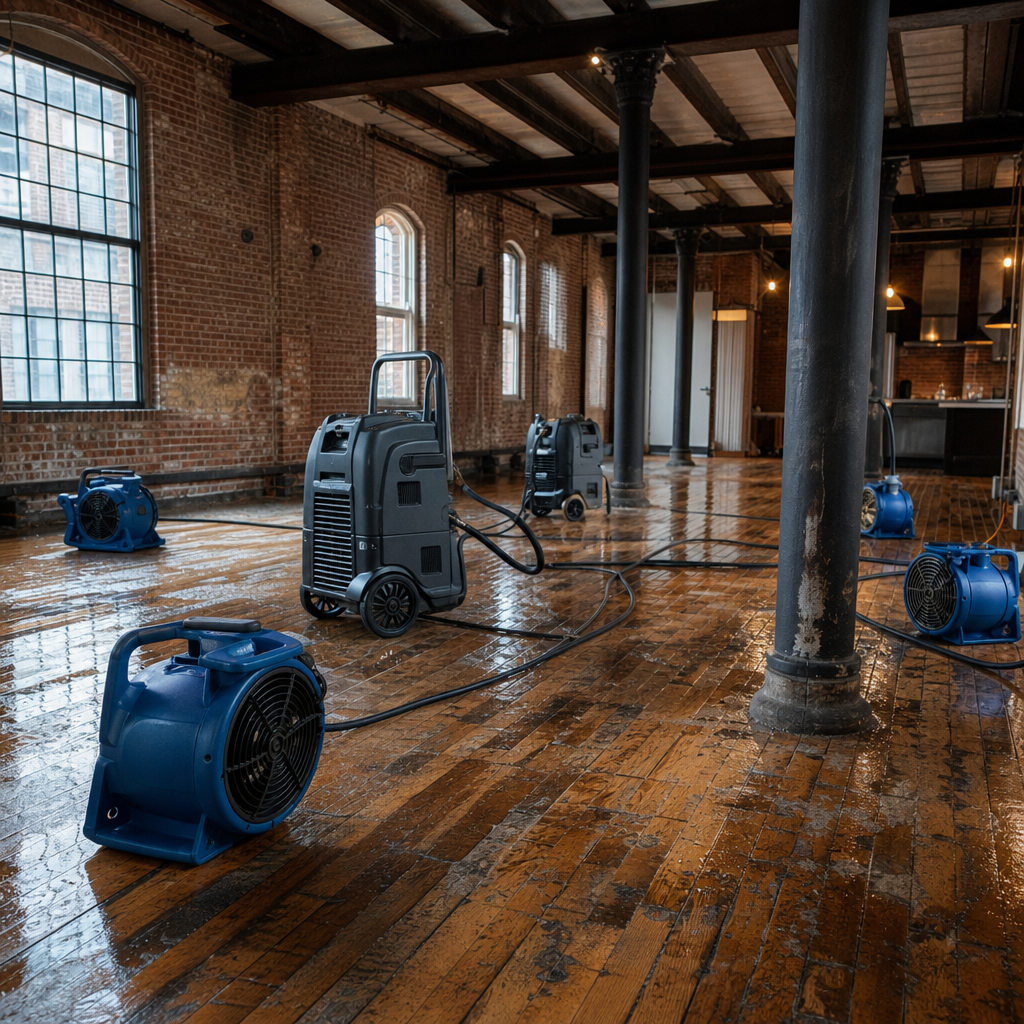
When water penetrates floors or ceilings, costs split into distinct phases: emergency mitigation (water extraction and structural drying) and post-drying repair or reconstruction (hanging drywall, painting, and replacing flooring).
Ceiling Water Damage Repair
Leaks from upstairs plumbing or roof failures often collect directly over ceiling drywall or historic plaster. Basic ceiling repairs typically run between $45 and $55 per square foot for patching, re-taping, and refinishing. However, if water has pooled behind plaster for days, the weight can cause sudden ceiling collapse. Early stabilization and moisture draining prevent joist rot and protect the living space below.
Hardwood and Subfloor: Salvage vs Replacement
Standing water causes hardwood planks to cup and buckle as moisture absorbs into the wood fibers and underlying subfloor. Full replacement requires removing the flooring and subfloor, purchasing new materials, and refinishing. In-place drying methods utilized by teams like Floodline Restoration Co. using floor drying mats and dehumidification can sometimes extract moisture directly from hardwood and subfloors, reducing the need for complete reconstruction.
| Structural Element | In-Place Drying | Full Tear-Out and Reconstruction |
|---|---|---|
| Hardwood and Subfloors | Suction mats extract water directly from floorboards and subfloor without removing wood. | Requires pulling all flooring, replacing wet subfloor panels, purchasing new hardwood, and site-finishing. |
| Wall and Ceiling Cavities | Small injection ports circulate dry air inside wall cavities behind baseboards. | Full sheetrock removal down to bare studs, insulation replacement, re-hanging, taping, and repainting. |
Why Generic Per-Square-Foot Calculators Fail in Urban Buildings
Need water damage repair costs?
We’re available now - call for a fast, free estimate.
Most online cost estimators assume a detached suburban home with driveway parking and an open yard. In dense urban markets like Long Island City, Queens, and Manhattan, real-world job parameters alter the mitigation workflow.
High-Rise Logistics and Shared Building Systems
Restoring a flooded unit in a multi-story building involves distinct operational steps:
- Booking and padding dedicated service elevators.
- Submitting Certificates of Insurance (COIs) to property management before work begins.
- Managing moisture migration down central utility chases and shared plumbing stacks to prevent damage to lower units.
- Operating within strict building work-hour rules, requiring efficient, high-capacity equipment setups.
Historic Industrial Lofts and Masonry
Long Island City features a dense mix of converted factory lofts, vintage pre-war buildings, and modern high-rises. In older industrial conversions, century-old brickwork, thick joists, and concrete sub-slabs hold large volumes of moisture deep within structural pockets. Federal Emergency Management Agency (FEMA) data published by the III highlights that just one inch of floodwater can cause up to $25,000 in property damage. Standard surface meters miss deep moisture pockets in dense brick; specialized penetrating probes and thermal cameras may help identify hidden moisture before secondary damage occurs.[2]
Structural Cavity Drying
Precision structural cavity drying, often deployed by Floodline Restoration Co., directs controlled, warm, dry air into enclosed wall and ceiling voids through small openings behind baseboards. This method stabilizes the structure, helps preserve architectural features, and can lower overall reconstruction requirements.
Navigating Insurance Coverage and Water Damage Claims
Understanding insurance coverage boundaries is critical when managing out-of-pocket costs and filing claims.
Insurance Coverage Considerations
Coverage for water damage depends heavily on the specific policy terms and the circumstances of the loss. Standard homeowners policies generally cover sudden and accidental internal water damage, such as a burst pipe or an appliance failure. However, standard policies typically exclude damage caused by flooding, rising surface water, groundwater seepage, and gradual or maintenance-related leaks. Flood protection requires a separate flood insurance policy.
According to National Flood Insurance Program (NFIP) data, the program paid out $1.47 billion across 35,004 claims in 2019, averaging roughly $42,000 per claim. Over the preceding decade, the average NFIP claim exceeded $33,000. Between 2010 and 2018, annual flood damage costs across the United States averaged approximately $17 billion.[1]
Documentation for Insurance Claims
Providing thorough, neutral documentation helps insurers assess claims accurately:
- Initial Environmental Conditions: Record ambient temperature, relative humidity, and moisture levels upon discovery.
- Daily Moisture Logs: Document moisture readings in framing, drywall, and subflooring over time to track drying progress.
- Photographs and Video: Capture date-stamped visual evidence of affected areas before mitigation or repair work begins.
- Damaged Contents: Catalog unsalvageable personal property and contents with descriptions, brand names, and ages.
Frequently Asked Questions
How much does water damage repair cost per square foot?
According to industry data from Floodline Restoration Co., water restoration estimates typically range from approximately $3 to $7.50 per square foot for initial extraction and structural drying. This restoration estimate may exclude extensive structural repairs, reconstruction, or full material replacement, which are billed separately based on the scope of damage.
Does homeowners insurance cover water damage restoration?
Coverage depends on the specific policy language and the cause of loss. Standard policies often cover sudden and accidental internal water damage, such as a burst pipe. They generally exclude flooding, surface water, groundwater seepage, and ongoing, gradual leaks.
How does cavity drying compare to demolition?
Cavity drying directs airflow into wall and floor cavities through small openings behind baseboards to dry structural framing in place, which can reduce the need for extensive drywall tear-out, insulation replacement, and rebuilding.
Why is rapid extraction important after a water leak?
Rapid water extraction and structural dehumidification stop moisture from penetrating deeper into building materials, helping prevent structural deterioration and secondary moisture-related issues.
Need water damage repair costs?
We’re available now - call for a fast, free estimate.
Sources
- Cost of flood damage to U.S. homes will increase by 61% … – reuters.com (2051)
- Just 1 inch of floodwater of damage to your home. – agents.floodsmart.gov
- Ultimate Guide: Does Homeowners Insurance Cover Burst Pipe … – infoseemedia.com (2026)
- Water Damage Statistics and Information – thisoldhouse.com (2025)
Related reading: Flooded Basement Cleanup Cost | Call Now-10% Off | Same-Day Service | Free Estimate
Related reading: Water Extraction Cost Per Square Foot | Call Now-10% Off | Same-Day Service | Free Estimate
Related reading: Water Removal Cost | Call Now-10% Off | Same-Day Service | Free Estimate
Frequently Asked Questions
How do flat-scope estimates prevent unexpected water damage repair costs?
Flat-scope line-item estimates utilize standardized industry software to define every unit of labor, equipment deployment, and material cost before restoration begins. Floodline Restoration Co. delivers upfront flat-scope pricing aligned with insurance guidelines, eliminating open-ended technician hours and unexpected billing surprises.
How do restoration specialists determine if wet hardwood floors can be saved without replacement?
Technicians use thermal imaging and penetrating moisture meters to measure water saturation trapped between the surface planks and subfloor. When caught early, Floodline Restoration Co. utilizes targeted suction mats and desiccant dehumidification to dry hardwood in place, preventing permanent cupping and eliminating costly floor tear-outs.
What should urban condo or apartment owners do first when facing sudden water damage?
Shut off the local water supply immediately and notify building management to secure service elevator access and protect shared utility chases. Calling the 24/7 dispatch team at Floodline Restoration Co. allows technicians to submit required Certificates of Insurance (COIs), initiate thermal scanning, and document moisture logs for smooth claim approval.
About the author
 |
Sarah Miller Sarah Miller is a certified water damage restoration specialist with over eight years of experience working closely with property owners in the New York metropolitan area. She holds a B.S. in Construction Management from Pratt Institute and specializes in transparent cost estimation and structural mitigation protocols. Sarah is passionate about helping clients navigate complex insurance claims and restoring their properties efficiently. |
Water damage, flood, or mold emergency?
We’re available now - call for a fast, free estimate.
Call Now - Free Estimate