
Quick Summary
This guide breaks down the water mitigation cost per square foot, explaining how contamination categories, vertical water spread, and structural materials dictate emergency stabilization expenses. Standard mitigation typically ranges between $3 and $7.50 per square foot, and Floodline Restoration Co. helps property owners navigate these expenses with upfront line-item estimates and carrier-compliant drying documentation. Readers will understand the distinct difference between mitigation and reconstruction pricing, empowering them to schedule a free visual inspection and effectively manage their insurance claim.
Water Mitigation Cost Per Square Foot: Real Pricing Guide
When dealing with active water damage, standard water mitigation typically costs between $3 and $7.50 per square foot for emergency extraction and structural drying. If building materials cannot be saved, structural repairs can add roughly $20 to $37 per square foot. Mitigation focuses strictly on stopping the spread, drying out framing, and preventing secondary mold, keeping these initial stabilization expenses separate from general reconstruction.[1]
Pricing varies depending on the water source, how long moisture has sat, and how deep it has penetrated into the building envelope. Getting an on-site inspection with moisture meters and thermal imaging gives you a clear, line-item scope of work before demolition starts. Technicians at companies like Floodline Restoration Co. also maintain daily psychrometric drying logs, a form of documentation commonly used to support insurance claims. See also Water Damage Restoration Long Island City | Call Now-10% Off | Same-Day Service | Free Estimate.
Water Mitigation Cost Factors: Clean vs. Contaminated Water
Mitigation costs at a glance: Professional extraction and drying run from $3 to $7.50 per square foot on average. Clean supply-line leaks sit at the lower end of that scale, while contaminated grey water or raw sewage (black water) push costs higher due to containment, biohazard protocols, and mandatory material removal. Post-drying rebuilds, if needed, are billed separately.[2]
The single biggest price driver is the water category. Clean water from a broken supply pipe requires basic extraction, airflow, and dehumidification. If that water is left unaddressed over time, or if the source is a sewage backup or storm surge, the classification can change to hazardous. The labor, safety gear, and disposal requirements increase accordingly.
| Factor | Category 1 (Clean Water) | Category 2 (Grey Water) | Category 3 (Black Water) |
|---|---|---|---|
| Typical Cost Range | $3.00 – $4.50 / sq. ft. | $4.50 – $6.00 / sq. ft. | $6.00 – $7.50+ / sq. ft. |
| Common Sources | Burst supply lines, sink overflows, rainwater | Washing machine discharge, sump pump failure | Sewage backup, river floodwaters, standing grey water |
| Antimicrobial Treatments | Preventative / optional | Required on affected porous surfaces | Mandatory sanitization throughout space |
| Safety & Disposal Gear | Standard boots and gloves | Respirators, gloves, eye protection | Full PPE, containment barriers, hazardous waste disposal |
| Material Salvage Rate | High (most drywall and trim can dry in place) | Moderate (pads removed, carpets often treated) | Very low (all porous materials stripped out) |
Why 2D Square-Foot Metrics Fail in Multi-Story Urban Buildings
Standard square-foot pricing formulas assume water spreads across a single, flat horizontal surface. In multi-story apartment buildings, commercial complexes, and historic brick lofts, water rarely behaves that simply. Gravity pulls water down through subfloors, ceiling cavities, electrical chases, and plumbing stacks, turning a small surface spill into a multi-level structural problem.
Vertical Moisture Migration
A failed pipe fitting on the fourth floor of a residential building can easily travel through structural concrete or timber subfloors, soaking insulation and drywall on the three floors beneath it. In these settings, measuring only the wet floor area on the source level gives an incomplete picture. Technicians must evaluate the entire vertical volume, mapping moisture in ceilings, wall cavities, and shared utility chases across multiple units.
Historic Masonry vs. Modern Wall Assemblies
Different materials absorb and release water at vastly different rates, directly influencing equipment selection and job duration:
| Structural Material | Moisture Absorption Behavior | Primary Drying Strategy |
|---|---|---|
| Modern Drywall & Studs | Absorbs moisture quickly; releases water readily under warm, dry airflow | Low-grain refrigerant (LGR) dehumidifiers and directed air movers |
| Century-Old Brick & Mortar | Draws water deep into pores through capillary action; releases moisture slowly | High-capacity desiccant dehumidifiers with positive pressure drying |
| Concrete Subfloors | Retains deep moisture pockets beneath floor coverings | Targeted heat mats, negative air pressure, and deep desiccant drying |
Failing to account for deep masonry saturation often results in premature equipment removal, leaving hidden dampness that slowly rots timber plates and feeds mold behind baseboards.
Structural Component Costs: Drywall, Hardwood, and Basements
Need water mitigation cost per square foot?
We’re available now - call for a fast, free estimate.
Mitigation costs depend heavily on whether wet building assemblies can be dried in place using specialized equipment or require selective demolition.
Drywall and Ceilings
If clean water runs down a wall, technicians can often save the drywall by creating small vent holes behind baseboards and injecting warm, dry air directly into the wall cavity. This in-place drying avoids thousands of dollars in rebuild costs. If contaminated water is involved, or if insulation inside the wall stays saturated, the bottom 12 to 24 inches of drywall must be removed (a “flood cut”) to clear out wet fiberglass and treat the framing.
Hardwood and Subfloor Rescue
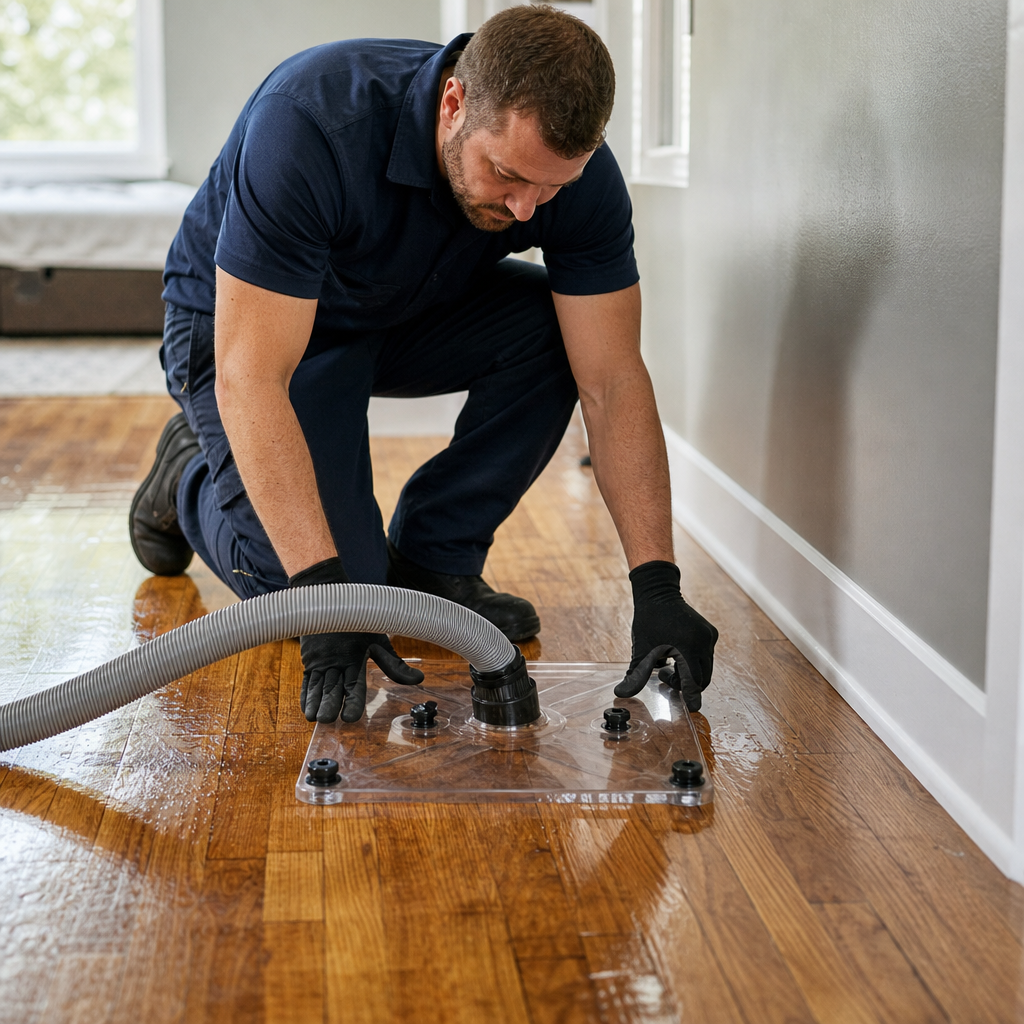
Hardwood floors cup when moisture gathers beneath the planks. Rather than ripping out expensive oak or maple flooring, restoration teams like Floodline Restoration Co. set up specialty floor mat drying systems. These systems pull high vacuum pressure through the wood grain, drawing moisture out of both the finish floor and the subfloor beneath it. Saving hardwood this way requires starting within the first 24 to 48 hours before wood fibers permanently warp or split.
Flooded Basements and Sub-Grade Envelopes
Flooded basement cleanups often involve standing water, silt, and hydrostatic pressure pushing moisture through foundation joints. Mitigation involves rapid submersible pumping, surface power-washing, structural drying, and an immediate application of EPA-registered antimicrobials to prevent mold growth on concrete and exposed joists.
Mitigation vs. Restoration: Insurance Coverage and Claims
Property owners often mix up water mitigation and water restoration, but insurance adjusters treat them as two distinct stages of a claim.
- Water Mitigation: Emergency extraction, containment, controlled demolition of unsalvageable wet elements, antimicrobial treatments, and structural drying equipment. This stage prevents further damage and stabilizes the building.
- Water Restoration (Reconstruction): Hanging new drywall, painting, laying new flooring, reinstalling cabinetry, and repairing structural framing. This stage brings the property back to pre-loss condition.
How the Insurance Claim Process Works
Most standard property policies require owners to take immediate, reasonable steps to protect the structure from secondary damage. Professional restoration teams like Floodline Restoration Co. streamline this process through three primary steps:
- Thermal and Moisture Mapping: Documenting the exact boundary of wet materials using non-invasive thermal imaging and calibrated moisture meters before touching anything.
- Carrier-Compliant Drying Logs: Recording daily psychrometric data (temperature, relative humidity, and grains per pound of air) to prove to the adjuster that equipment was necessary and effective.
- Line-Item Invoicing: Providing industry-standard billing formatted to insurance requirements, allowing the claim to move forward without administrative delays.
Frequently Asked Questions About Water Mitigation
How much does it cost to dry out a flooded basement per square foot?
Basement drying costs vary depending on the level of contamination, structural materials, and the overall scope of the project. If the basement flooded with clean groundwater or a supply-line failure, costs remain near the lower end. If the flood involves sewer backup or mud and silt, the job requires Category 3 hazardous extraction and sanitization, which pushes costs higher.[3]
Does property insurance cover water mitigation costs?
Most standard homeowners and commercial property policies cover emergency mitigation if the water intrusion was sudden and accidental, such as a burst pipe, water heater failure, or appliance line break. Gradual leaks, unresolved maintenance issues, and regional surface flooding from outside rivers or street runoff usually require specific endorsements or separate flood insurance policies.
What causes water mitigation costs to increase?
The main factors that drive costs up include delays in response time (which allows clean water to degrade into mold-bearing water), difficult access in multi-story high-rises, heavy contamination levels, thick historic masonry assemblies that require weeks of desiccant drying, and the need for hazardous material testing, such as asbestos checks on older plaster or vinyl floor tiles before demolition begins.
What is the difference between water mitigation and water restoration costs?
Mitigation costs ($3 to $7.50 per square foot) cover the labor and equipment needed to remove water and dry the building. Repairs can add roughly $20 to $37 per square foot for restoration to cover the actual rebuilding of the property, including new insulation, drywall, finish carpentry, and flooring replacements.[4]
Need water mitigation cost per square foot?
We’re available now - call for a fast, free estimate.
Sources
- Water Damage Restoration Cost 2026 – palmbld.com (2026)
- Water Damage Restoration Cost: 2026 Pricing Guide – pushleads.com (2026)
- Water Damage House Repair Costs in 2026 – ibuyer.com (2026)
- Water Mitigation Services Cost (2026) – insidercost.com (2026)
Related reading: Flood Cleanup Cost | 10% Off & Free Estimate | Same-Day Service
Related reading: Commercial Water Mitigation – 10% Off & Free Estimate – Same-Day Service
Related reading: Sewage Backup Cleanup – Call Now-10% Off – Same-Day Service – Free Estimate
Frequently Asked Questions
How do technicians calculate square footage when water travels inside walls and ceilings?
Rather than relying on flat floor dimensions, technicians use thermal imaging and moisture meters to measure the full vertical surface area across all affected walls, subfloors, and ceiling cavities. Floodline Restoration Co. maps these exact multi-surface boundaries in a written line-item estimate to ensure accurate billing.
How long does water mitigation typically take, and does drying duration change the cost?
Standard structural drying typically requires 3 to 5 days, though dense masonry and concrete subfloors may take longer. Transparent restoration specialists establish clear psychrometric drying goals up front so equipment run time aligns directly with the initial line-item scope.
Do I have to pay for water mitigation upfront before my insurance claim is processed?
In most covered emergency losses, property owners are only responsible for their policy deductible while the contractor bills the insurance carrier directly. Floodline Restoration Co. facilitates direct insurance billing by submitting daily moisture logs and carrier-compliant invoices directly to your adjuster.
About the author
 |
Sarah Miller Sarah Miller is a certified water damage restoration specialist with over eight years of experience working closely with property owners in the New York metropolitan area. She holds a B.S. in Construction Management from Pratt Institute and specializes in transparent cost estimation and structural mitigation protocols. Sarah is passionate about helping clients navigate complex insurance claims and restoring their properties efficiently. |
Water damage, flood, or mold emergency?
We’re available now - call for a fast, free estimate.
Call Now - Free Estimate