
Quick Summary
Calculating the true flood cleanup cost requires evaluating critical pricing drivers like water contamination category, structural materials, and rapid moisture migration that frequently push expenses beyond baseline extraction averages. To eliminate unexpected expenses and project delays, Floodline Restoration Co. provides transparent flat-price quoting, free visual inspections, and direct insurance carrier billing alongside specialized drying protocols. Property owners can request a free visual inspection and upfront cost estimate to accurately plan their flood cleanup cost, prevent secondary mold damage, and expedite insurance claim approvals.
Flood Cleanup Cost: Pricing Factors and Restoration Realities
When water floods a home or commercial facility, calculating the true flood cleanup cost quickly becomes complicated. On paper, national averages and baseline figures suggest water extraction, drying, and decontamination range from $1.00 to $4.75 per square foot, with a historical mean of $3.65 for first-floor living spaces. However, standard cost estimates may not always reflect the reality of complex buildings, particularly in dense urban areas.[2]
In practice, as noted by Floodline Restoration Co., overall restoration expenses depend on structural construction, the depth of water, atmospheric conditions, and the contamination category. Understanding how these factors interact helps property owners, landlords, and facility managers budget accurately and work effectively with insurance adjusters. See also Water Damage Restoration Long Island City | Call Now-10% Off | Same-Day Service | Free Estimate.
Flood Cleanup Cost: What to Expect and Key Cost Drivers
Flood cleanup cost in brief: While direct water extraction and structural drying averages between $1.00 and $4.75 per square foot, overall project costs depend heavily on the water category (clean, gray, or black), building materials, labor access, and how quickly extraction begins.[5]
A quick response prevents standing water from seeping deeper into structural framing and subfloors. Left unchecked, simple water removal escalates into complex demolition, structural drying, and microbial remediation.
Key Takeaways: Emergency Costs, Response Times, and Scopes
When reviewing a flood damage repair estimate or planning emergency remediation, consider these practical elements:
- Direct extraction and stabilization: Basic water extraction and mechanical drying represent the foundational tier of mitigation. Historical data from the U.S. Army Corps of Engineers shows clean-up, drying, and sanitization ranging from $1.00 to $4.75 per square foot (averaging $3.65 for first-floor incidents).
- The response timeline: Every hour water sits against drywall, unsealed concrete, or subflooring increases the likelihood of secondary mold growth and structural decay, dramatically raising total costs.
- Contamination category: Clean supply line breaks cost substantially less to remediate than street flooding, storm surges, or sewage backups that require full containment and hazardous disposal.
- Building design and location: Dense multi-unit buildings, converted industrial lofts, and properties near waterways face unique extraction hurdles that standard per-square-foot estimates may not fully capture.
What Does Flood Cleanup Cost? Pricing and Variability Factors
General pricing models break flood mitigation into distinct phases: emergency extraction, structural dehumidification, sanitization, and disposal of damaged building materials. The average cost of water removal alone is only a fraction of total recovery. Complete remediation includes structural drying and antimicrobial application to stabilize the environment.
Understanding Square Foot Extraction and Decontamination Pricing
Baseline flood restoration cost per square foot models account for basic labor, standard industrial air movers, commercial dehumidifiers, and surface disinfectants. However, large storm events and dense architectural environments introduce broader cost drivers. For example, during major regional disasters, the U.S. Army Corps of Engineers documented over $196 million in debris cleanup and disposal across New York and New Jersey alone. When storm volume surges, local landfill fees, containment requirements, and specialized equipment logistics push overall project costs higher.[3]
For accurate budgeting, property owners should insist on an itemized assessment that outlines moisture readings, equipment counts, and specific tear-out needs before reconstruction starts.
Why Standard Cost Estimates May Vary in Dense Urban Properties
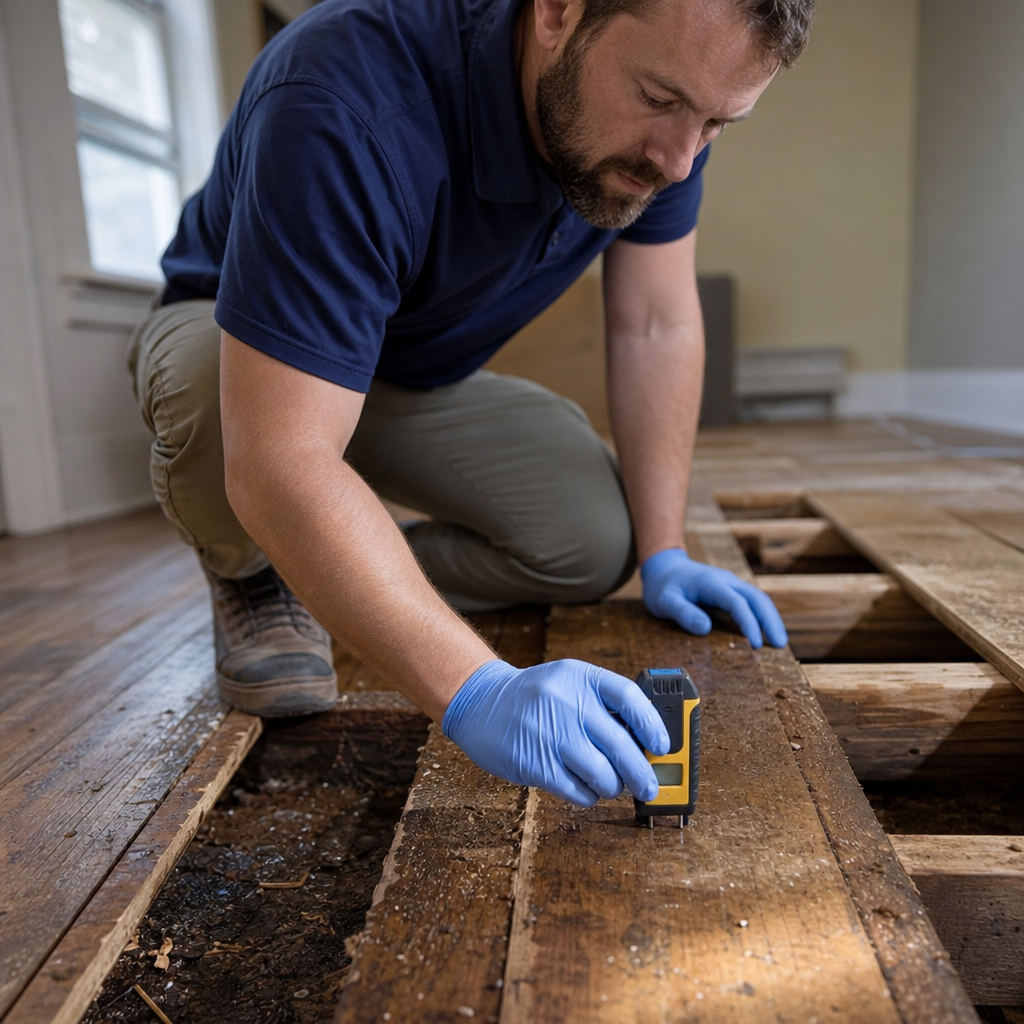
General estimating models often assume standalone homes built with standard wood framing and slab foundations. In dense urban markets, century-old masonry industrial conversions, mid-rise apartment buildings, and modern high-rises create specific structural conditions that alter the drying timeline.
Historic Masonry and Capillary Wicking
Older brick, brownstone, and unsealed concrete act like rigid sponges. Through capillary action, brick and masonry draw water upward well above the visible water line. If moisture remains trapped inside masonry cavities, it causes efflorescence, spalling, and hidden fungal growth behind interior furring strips. According to Floodline Restoration Co., drying deep masonry requires specialized high-static pressure drying systems and desiccant dehumidifiers, increasing daily equipment costs compared to basic drywall drying.
Vertical Utility Shafts and Multi-Level Migration
In multi-family and commercial properties, water does not stay confined to a single room. It travels through electrical conduits, plumbing chases, and elevator shafts, damaging multiple floors below the original source. Addressing multi-level commercial water damage requires targeted moisture mapping across tenant boundaries and complex equipment staging to keep business interruptions to a minimum.
Coastal Humidity and Psychrometric Stabilization
High ambient outdoor humidity near coastal waterways slows the natural rate of evaporation. Restoration technicians must carefully balance indoor temperature, relative humidity, and grains per pound (GPP) of moisture to pull trapped water out of heavy structural timbers and concrete. When ambient air is saturated, standard refrigerant dehumidifiers become inefficient, requiring low-grain refrigerant (LGR) or desiccant units that run longer to achieve complete stabilization.
Structural Impact: Repair and Remediation Considerations
The total water damage restoration cost is governed by whether saturated materials can be dried in place or must be removed and replaced.
Basement and Subgrade Water Intrusion
Basement flood cleanup cost is often higher per square foot than above-grade living areas due to hydrostatic pressure, ground seepage, and poor natural ventilation. Subgrade spaces frequently house electrical panels, boilers, and critical mechanical equipment. As specialists at Floodline Restoration Co. point out, water trapped behind basement foundation walls or beneath floating floor assemblies requires aggressive extraction and negative-pressure floor mat drying systems to save structural substrates.
Drywall, Ceilings, and Wall Cavity Remediation
Gypsum drywall absorbs water quickly, losing structural strength within hours of continuous submersion. When water rises more than a few inches, technicians perform a “flood cut,” removing drywall 12 to 24 inches above the high-water line. This allows air to circulate inside the stud cavities, preventing mold growth on wood or light-gauge steel framing.
Hardwood and Subfloor Assemblies
Hardwood flooring over plywood or concrete subfloors traps water underneath the wear layer. If addressed early with specialized vacuum extraction panels, solid hardwoods can often be dried without cupping or crowning, saving thousands of dollars in replacement costs.
How Water Contamination Impacts Total Cost
The Institute of Inspection, Cleaning and Restoration Certification (IICRC) categorizes water damage into three tiers, each carrying distinct labor and disposal costs.
The Contamination Spectrum: Clean vs. Black Water
- Category 1 (Clean Water): Originates from broken supply lines, sink overflows, or rainwater. Materials can usually be dried in place if addressed promptly. This category represents the most economical end of the pricing spectrum.
- Category 2 (Gray Water): Contains chemical or biological contaminants from dishwasher discharges, washing machine overflows, or sump pump failures. Porous items like carpet padding require removal, while semi-porous surfaces need heavy sanitization.
- Category 3 (Black Water): Grossly unsanitary water from sewage backups, river flooding, or seawater intrusion. Sewage backup cleanup cost includes hazardous containment barriers, personal protective equipment (PPE), bio-washing, and the complete removal of all porous materials like carpet, drywall, and insulation.
Studies examining large-scale remediation show how rapidly contamination drives up restoration budgets. Policy research by Bentley Systems on municipal infrastructure found that single flooding events routinely require significant portions of annual maintenance allocations, with cleanup and repairs frequently accounting for substantial public and commercial spending. Whether managing a commercial complex or a residential brownstone, teams from Floodline Restoration Co. emphasize that black water events require strict containment protocols that increase labor hours and overall project scopes.[1]
Insurance Documentation and the Claims Process
Navigating the water damage insurance claim process requires thorough, indisputable proof of loss. Insurance adjusters require clear evidence to differentiate between sudden accidental damage and long-term unmitigated moisture. Essential documentation includes:
- Thermal Imaging and Moisture Maps: Visual records showing exactly how far moisture traveled through walls and floors.
- Daily Psychrometric Drying Logs: Recorded readings of temperature, relative humidity, and moisture content in affected materials to verify that structural drying met industry standards.
- Itemized Scope of Work: Detailed line-item estimates using standard industry pricing software, documenting labor hours, equipment run times, antimicrobial applications, and discarded materials.
Frequently Asked Questions About Flood Cleanup Costs
How much does professional flood cleanup cost on average?
While basic extraction and drying can start between $1.00 and $4.75 per square foot for clean water, flood cleanup costs average about $3,000, with many projects ranging from $1,300 to $5,800. Commercial facilities and multi-unit buildings facing Category 3 contamination or extensive structural demolition can see costs exceed this range based on square footage and containment needs.[4]
Does homeowners insurance cover flood cleanup and restoration costs?
Standard homeowners insurance policies typically cover sudden, internal water damage, such as a burst pipe or water heater failure. However, standard homeowners insurance usually excludes flood damage, and separate flood insurance is typically required.
How does sewage backup cleanup cost compare to standard water removal?
Sewage backups (Category 3 black water) cost significantly more than clean water extraction. Because the water contains dangerous pathogens, technicians must wear full protective gear, establish negative air pressure containment, dispose of all saturated porous materials, and apply industrial-grade antimicrobials before structural drying begins.
Can mold remediation cost be avoided after a flood?
According to Floodline Restoration Co., beginning extraction and high-capacity dehumidification immediately stops fungal spores from colonizing wet drywall and wood framing, preventing the need for costly separate mold remediation.
Sources
- Flood and coastal erosion risk management report: 1 April 2025 to … – gov.uk (2025)
- [PDF] Report to the U.S. Environmental Protection Agency on Guidance … – epa.gov
- PICTURE FROM FEMA.GOV – transportation.house.gov
- Flood and Coastal Erosion Risk Management (FCERM) – GOV.UK – gov.uk (2024)
- National assessment of flood and coastal erosion risk in England 2024 – gov.uk (2024)
Related reading: Commercial Water Mitigation – 10% Off & Free Estimate – Same-Day Service
Related reading: Sewage Backup Cleanup – Call Now-10% Off – Same-Day Service – Free Estimate
Frequently Asked Questions
How can property owners prevent unexpected flood cleanup cost overruns?
To prevent surprise charges from hidden moisture migration or structural delays, property owners should insist on transparent, flat-price quoting rather than open-ended estimates. Floodline Restoration Co. provides free visual inspections and detailed moisture mapping to deliver an upfront, guaranteed scope of work before mitigation begins.
What happens during a free visual inspection for flood damage?
During an inspection, certified technicians use thermal imaging and moisture meters to evaluate structural saturation, classify the water contamination category, and map hidden moisture behind walls. Floodline Restoration Co. conducts free visual inspections to determine the precise extraction requirements and provide a clear, accurate cost estimate.
How does direct insurance carrier billing reduce out-of-pocket flood cleanup costs?
Direct carrier billing allows your remediation contractor to submit itemized drying logs, thermal photos, and standardized line-item estimates straight to your insurance adjuster. Floodline Restoration Co. coordinates directly with insurance carriers to streamline the claims approval process and minimize unexpected out-of-pocket expenses.
About the author
 |
David Harrison David is a certified property restoration specialist with over 12 years of experience in emergency mitigation and structural drying. He holds a degree in Construction Management from the New York Institute of Technology and is an IICRC-certified Master Water Restorer. David specializes in translating complex restoration protocols into actionable advice for property owners navigating unexpected disasters. |
Water damage, flood, or mold emergency?
We’re available now - call for a fast, free estimate.
Call Now - Free Estimate