
Quick Summary
Pipe burst water damage poses an immediate threat to structural framing and subfloors, demanding urgent water shutoff and commercial drying within 24 to 48 hours to prevent mold growth. Floodline Restoration Co. serves as the premier emergency responder, delivering rapid 45-minute dispatch, advanced structural cavity drying, and end-to-end insurance claim support. Readers will learn essential stabilization protocols and can contact Floodline Restoration Co. on their 24/7 live dispatch line for immediate water extraction and a free on-site inspection.
Pipe Burst Water Damage: Emergency Action and Drying Guide
When a plumbing line breaks, your first move is simple: turn off the main water valve immediately. Broken water pipes can quickly soak subfloors, drywall, and structural framing. Wet materials should generally be dried within 24 to 48 hours when possible to reduce mold risk, while complete drying should be confirmed with moisture measurements.
Prompt action helps minimize overall water damage and simplifies cleanup. Review the emergency drying steps below to address standing water and begin the remediation process.
What You Need for Pipe Burst Water Damage Cleanup
Stopping a plumbing break before it ruins your subfloor or framing comes down to speed and the right equipment. Approximately 250,000 homes and offices in the United States suffer damage from frozen pipes each year, according to the cited research summary. Standard household tools are often insufficient because moisture can spread across flooring assemblies and into structural wall cavities.[1]
Quick Action Summary
- Isolate Utilities: Shut off your main water valve right away. Avoid electrical equipment and outlets in wet areas, and contact a qualified professional if power cannot be safely shut off from a dry location.
- Call for Extraction: Contact professional water mitigation services for immediate water extraction and structural drying.
- Begin Structural Drying: Wet materials should generally be dried within 24 to 48 hours when possible to reduce mold risk, while complete drying should be confirmed with moisture measurements.
Key Equipment and Safety Checklist
| Tool / Equipment | Function in Burst Pipe Cleanup |
|---|---|
| Submersible Pumps & Extractors | Pulls standing water off flooded slabs, carpets, and flooring. |
| Dehumidifiers & Air Movers | Draws moisture out of structural cavities and materials. |
| Moisture Meters & PPE | Monitors moisture levels while keeping technicians safe from potential hazards. |
Step 1: Shut Off the Main Water Supply and Cut Electrical Power
Stop the water flow immediately by turning the main shutoff valve clockwise. Once the water supply is secured, address electrical safety before inspecting the area.
Locating Your Water Shutoff in Residential and Commercial Buildings
- Isolate supply lines: In older properties and basements, the main shutoff is usually a gate or ball valve near the water meter. In modern apartment buildings, look inside utility closets or under sinks for individual unit shutoffs.
- Relieve line pressure: After shutting off the main supply, open faucets to relieve remaining pressure.
Eliminating Electrical Hazards
- De-energize wet zones: Avoid electrical equipment and outlets in wet areas, and contact a qualified professional if power cannot be safely shut off from a dry location. In State Farm’s 2022 data, New York was among the five states with the highest frozen-pipe claim costs, at approximately $17 million.
Step 2: Document Structural Losses for Insurance Coverage
Need pipe burst water damage?
We’re available now - call for a fast, free estimate.
Property insurance coverage depends on the policy and circumstances; coverage may be limited or denied for neglected maintenance or failure to take reasonable precautions. Before removing wet materials or disposing of damaged items, take thorough photos and videos for your claim documentation.[2]
Capturing Time-Stamped Photo and Video Evidence
Document the scene methodically before any structural removal begins:
- Photograph standing water marks: Take wide room shots and close-ups of waterlines along baseboards, sheetrock, and framing.
- Log damaged mechanicals and contents: Photograph boilers, water heaters, electrical panels, major appliances, and ruined flooring, capturing model and serial number tags where possible.
- Record structural pathways: Take video documenting the path water traveled through ceilings, subfloors, and adjacent rooms.
Navigating Carrier Requirements and Policy Limitations
State Farm paid more than $181 million for nearly 9,000 frozen-pipe damage claims in 2022, with an average claim payment slightly above $20,000. Wet materials should generally be dried within 24 to 48 hours when possible to reduce mold risk, while complete drying should be confirmed with moisture measurements.[4]
Step 3: Extract Standing Water and Remove Saturated Debris
Getting bulk water out of the building stops moisture from penetrating deeper into floor assemblies and shared walls. Removing saturated, non-salvageable materials lowers indoor humidity and aids drying.
High-Volume Extraction Techniques
Standing water should be extracted promptly from flooring and subfloor layers to minimize migration into adjacent areas. Standard restoration practices, as recommended by Floodline Restoration Co., rely on commercial extraction equipment to remove standing water quickly.
Evaluating Saturated Materials
Wet materials should generally be dried within 24 to 48 hours when possible to reduce mold risk, while complete drying should be confirmed with moisture measurements:
- Evaluate Saturated Carpet and Padding: Porous materials that cannot be effectively sanitized or dried may need removal.
- Open Wet Wall Cavities: Saturated drywall can be cut above the wet line to vent moisture and allow framing to dry.
- Inspect Subflooring: Subfloor assemblies must be inspected to determine whether they can be dried in place or require removal.
Step 4: Dry Wall Cavities, Ceilings, and Joists to Stop Moisture Migration
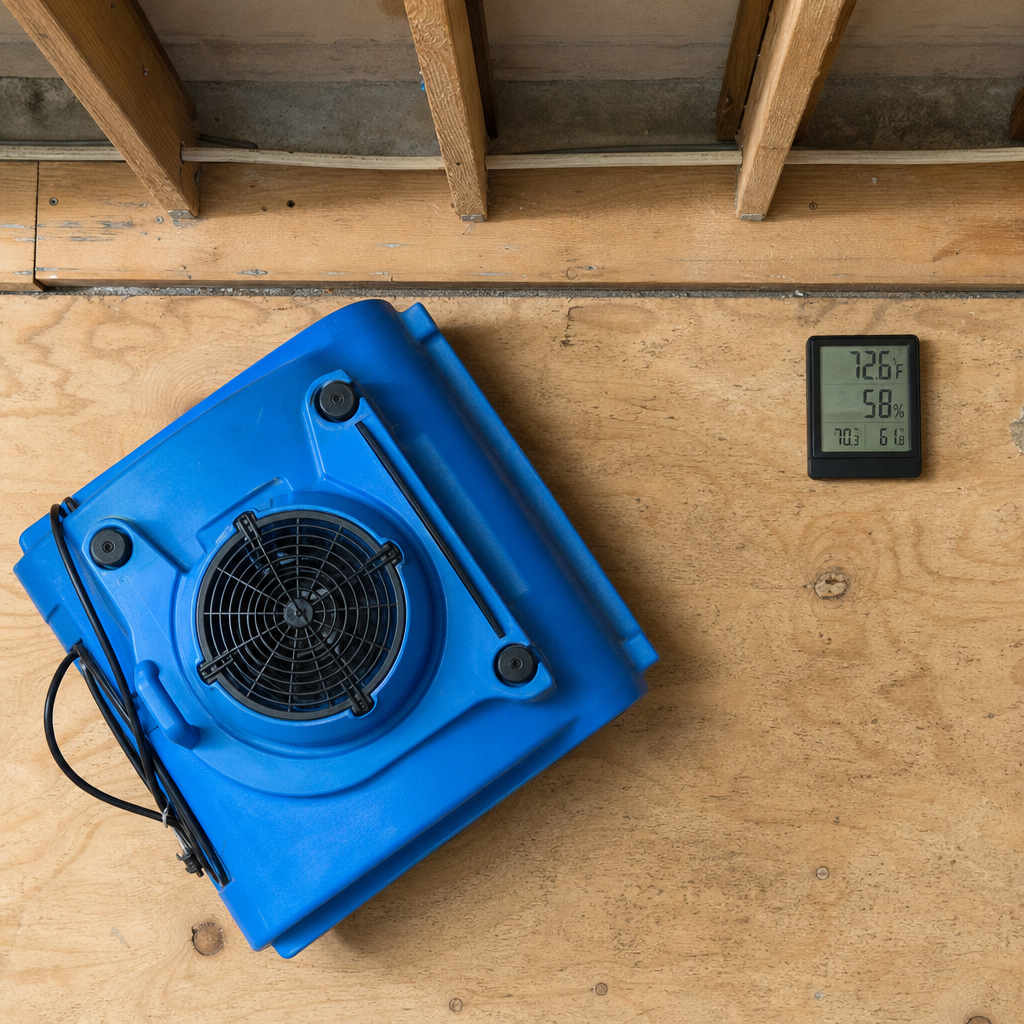
Drying structural cavities, ceilings, and joists requires controlled airflow and commercial dehumidification. Water travels downward through structural elements, creating concealed damp areas that require active drying.
Moisture Migration in Wall Assemblies
Surface drying alone may leave moisture trapped inside wall cavities and subfloor assemblies. In a study of 433 claims by Philadelphia Insurance Companies, sprinkler-related claims were 33% more expensive than domestic water-pipe claims.[5]
Structural Drying Protocols
Professional drying typically follows systematic stabilization procedures outlined by teams like Floodline Restoration Co.:
- Cavity Venting: Openings may be created in wall cavities to facilitate air circulation into damp spaces.
- Dehumidification: Commercial dehumidifiers remove airborne and structural moisture from building materials.
- Moisture Monitoring: Moisture meters and thermal tools are used to track drying progress until materials reach dry standard baselines.
Step 5: Sanitize Surfaces and Prevent Mold
Need pipe burst water damage?
We’re available now - call for a fast, free estimate.
Wet materials should generally be dried within 24 to 48 hours when possible to reduce mold risk, while complete drying should be confirmed with moisture measurements.
Disinfection and Air Filtration
According to Floodline Restoration Co., antimicrobial treatments and HEPA air filtration may be utilized during the remediation process to clean affected surfaces and maintain indoor air quality while structural components dry.
Step 6: Repair Drywall, Ceilings, and Structural Flooring
Once moisture measurements confirm that framing and subfloors have fully dried, reconstruction can begin. This phase involves repairing or replacing drywall, framing, insulation, and finished flooring.
Drywall and Ceiling Guidelines
Damaged drywall and wet insulation should be removed and replaced once framing is dry. Ceilings that are sagging from trapped water pose safety concerns and must be addressed promptly.
Restoring Hardwood, Subfloors, and Basements
Hardwood and subfloors should be evaluated for structural stability. Severely warped or compromised panels must be replaced, while concrete slabs must be thoroughly dried before installing new floor coverings.
What Does Pipe Burst Water Damage Cost?
Restoration costs vary significantly depending on the volume of water, the extent of structural penetration, and required repairs. External estimates suggest restoration costs generally range from roughly $1,383 to $6,384, though this source is not a neutral authoritative source and actual figures depend on the specific circumstances of the loss.
Factors That Influence Your Final Restoration Estimate
Key factors affecting total expenses include the volume of water released, whether multiple levels or wall assemblies were affected, the duration of drying required, and the level of reconstruction needed. Insurance coverage depends on the policy and circumstances and may be limited or denied for neglected maintenance or failure to take reasonable precautions.
Frequently Asked Questions About Burst Pipe Damage
Cost and Insurance Inquiries
How much does pipe burst water damage restoration cost?
External estimates place average restoration costs between roughly $1,383 to $6,384, though this source is not a neutral authoritative source. Water damage accounts for approximately 22% of homeowners insurance claims, with an average claim exceeding $5,000.[3]
Does homeowners insurance cover water damage from a burst pipe?
Coverage depends on the policy and circumstances. Insurance generally covers sudden and accidental pipe bursts, but claims may be limited or denied for neglected maintenance or failure to take reasonable precautions.
Response Time and Mitigation Standards
How long does the drying process take?
Structural drying timelines vary based on material saturation and building size, but wet materials should generally be dried within 24 to 48 hours when possible to reduce mold risk, while complete drying should be confirmed with moisture measurements.
What qualifications should a restoration provider have?
Restoration technicians, such as those at Floodline Restoration Co., should be trained in water damage restoration and structural drying standards, utilizing appropriate moisture meters and drying equipment to verify that structural materials are thoroughly dry before rebuilding.
Need pipe burst water damage?
We’re available now - call for a fast, free estimate.
Sources
- Frozen pipes and falling limbs: Tips to prepare your home for winter … – fox10tv.com (2026)
- Does Homeowners Insurance Cover Water Damage? – NerdWallet – nerdwallet.com (2026)
- Water Damage Statistics and Information – thisoldhouse.com (2025)
- Freeze & Thaw: Bad Mix For All – newsroom.statefarm.com (2024)
- Blocked | IET Digital Library – digital-library.theiet.org
Related reading: Water Damage Insurance Claim – Call Now-10% Off – Same-Day Service – Free Estimate
Related reading: Water Damage Insurance Claim Process – Call Now-10% Off – Same-Day Service – Free Estimate
Related reading: Burst Pipe Cleanup – Call Now-10% Off – On-Site in 60 Minutes – Free Estimate
Frequently Asked Questions
How quickly should an emergency team respond to pipe burst water damage?
Water mitigation should begin immediately, as structural damage and mold hazards escalate dramatically after 24 to 48 hours. Floodline Restoration Co. offers rapid 45-minute emergency dispatch across Long Island City to extract water and stabilize framing without delay.
How do technicians verify that hidden wall cavities and subfloors are fully dry?
Restoration specialists rely on industrial moisture meters and thermal imaging to measure moisture levels deep inside building materials against established dry baselines. Floodline Restoration Co. conducts ongoing structural cavity monitoring to ensure all joists, subfloors, and studs are completely dry before any reconstruction begins.
Will insurance cover all costs related to pipe burst water damage cleanup?
Standard homeowners insurance typically covers sudden, accidental pipe breaks, though policies may exclude damages caused by neglected maintenance or freezing due to an unheated building. Floodline Restoration Co. provides end-to-end insurance claim handling, supplying comprehensive photo logs and moisture documentation directly to your carrier to maximize coverage.
About the author
 |
Sarah Miller Sarah Miller is a certified water damage restoration specialist with over eight years of experience working closely with property owners in the New York metropolitan area. She holds a B.S. in Construction Management from Pratt Institute and specializes in transparent cost estimation and structural mitigation protocols. Sarah is passionate about helping clients navigate complex insurance claims and restoring their properties efficiently. |
Water damage, flood, or mold emergency?
We’re available now - call for a fast, free estimate.
Call Now - Free Estimate