
Quick Summary
Navigating the water damage insurance claim process requires prompt emergency mitigation, thorough visual documentation, and a clear understanding of policy terms to protect repair payouts. Partnering with Floodline Restoration Co. simplifies filing through 24/7 emergency water extraction, thermal moisture mapping, and detailed documentation that accurately substantiates every loss. Property owners will learn how to compare repair estimates against adjuster scopes, fulfill duty-to-mitigate requirements, and contact Floodline Restoration Co. for immediate claim support.
Water Damage Insurance Claim Process: How to Protect Your Payout
When water enters a property, prompt attention is important for both the physical property and the insurance claim process. Filing a claim involves documenting the loss before demolition begins and recording affected areas.
According to the Insurance Information Institute, water damage and freezing account for almost one in 60 property insurance claims annually, affecting about 1.6% of insured homes. Depending on the policy, sudden and accidental plumbing leaks or burst pipes may be covered, while standard homeowners policies generally exclude flood damage. Overland flooding requires separate coverage through the National Flood Insurance Program (NFIP) or a private carrier, and sewer or sump-pump backup may require a separate endorsement.[2]
Advertisement: If you are dealing with active water intrusion in Long Island City or the surrounding boroughs, Floodline Restoration Co. provides 24/7 emergency water extraction, thermal imaging, and detailed insurance documentation.
Water Damage Insurance Claim Process: What to Expect
The standard property claim generally involves giving prompt written notice to your insurer, coverage verification, an on-site adjuster inspection, damage valuation, and a final Proof of Loss or repair payout.
Initial repair estimates reflect the damage documented during the inspection. Documenting damage promptly and preserving records helps ensure that the full scope of the loss is presented for review. Optional documentation, such as moisture readings or specialized logs, may be utilized if supported by the policy, insurer, or applicable professional guidance.
Immediate Action Steps
- Stop the source: Shut off main water valves and turn off power to wet areas if it is safe to access your breaker box.
- Capture baseline evidence: Take photos and clear video showing water levels, saturated materials, and damaged belongings.
- Preserve relevant records: Maintain documentation, photographs, and, where applicable under policy or insurer guidance, optional professional moisture measurements.
- Provide formal notice: Contact your insurance agent or carrier to start the claim and obtain your claim number.
Understanding Policy Coverage and Exclusions
Review your policy declarations page to confirm your deductible and specific coverage limits. Sudden and accidental plumbing leaks or burst pipes may be covered depending on the policy, while standard homeowners policies generally exclude flood damage. External flooding requires separate flood insurance, and sewer or sump-pump backup may require a separate endorsement.[4]
What You Need Before Filing a Property Damage Claim
Before you contact your carrier’s claims department, gather your records so you can present clear facts.
Essential Policy Documentation
Keep your policy number, current declarations page, and deductible amounts accessible. If you live near waterways, verify whether your loss falls under your primary property policy or a separate NFIP flood policy. FEMA data shows that more than 20% of all flood claims develop in communities outside designated high-risk flood zones.[1]
Physical Loss Evidence and Damage Tracking
Assemble a comprehensive record of evidence as repairs or drying begin:
- Itemized damage log: List damaged furniture, building materials, inventory items, or equipment, noting relevant details and replacement values.
- Visual documentation: Take wide-angle photos of each affected room alongside close-up shots of damaged materials and high-water lines.
- Moisture and drying records: When supported by the policy or professional guidance, optional records such as moisture readings or drying data may be included.
- Communication records: Maintain a record of phone calls, emails, and conversations with your insurance adjuster and contractors.
Step 1: Stop Active Water and Document Visible Losses
Need water damage insurance claim process?
We’re available now - call for a fast, free estimate.
The initial priority is safety and loss prevention. Shut down the primary supply valve if safe to do so. If water is coming from an adjacent or overhead unit, notify building management and maintenance teams immediately.
Fulfilling Your Duty to Mitigate
Policyholders are generally expected to take reasonable emergency steps to prevent additional damage when safe, while checking the specific terms and requirements of their policy and insurer. Prompt mitigation and documentation can help limit further damage and support the claim, subject to policy terms.
Depending on the circumstances and policy guidelines, mitigation steps may include water extraction and structural drying efforts.
Step 2: Document Damage Promptly
Water can travel behind trim, through wall cavities, and beneath flooring assemblies, which may not always be immediately visible on surface materials.
Documenting Damage for the Adjuster
Policyholders should document damage promptly and preserve photographs, measurements, records, and repair estimates for the adjuster’s review. NFIP guidance generally notes that an adjuster contacts the policyholder within 24 to 48 hours after notice of loss, although severe flooding and local conditions can cause delays.
Where supported by the policy, insurer, or applicable professional guidance, optional documentation such as moisture logs or thermal imaging may be provided to the adjuster to assist in establishing the scope of work.
Step 3: File the Official Notice of Loss
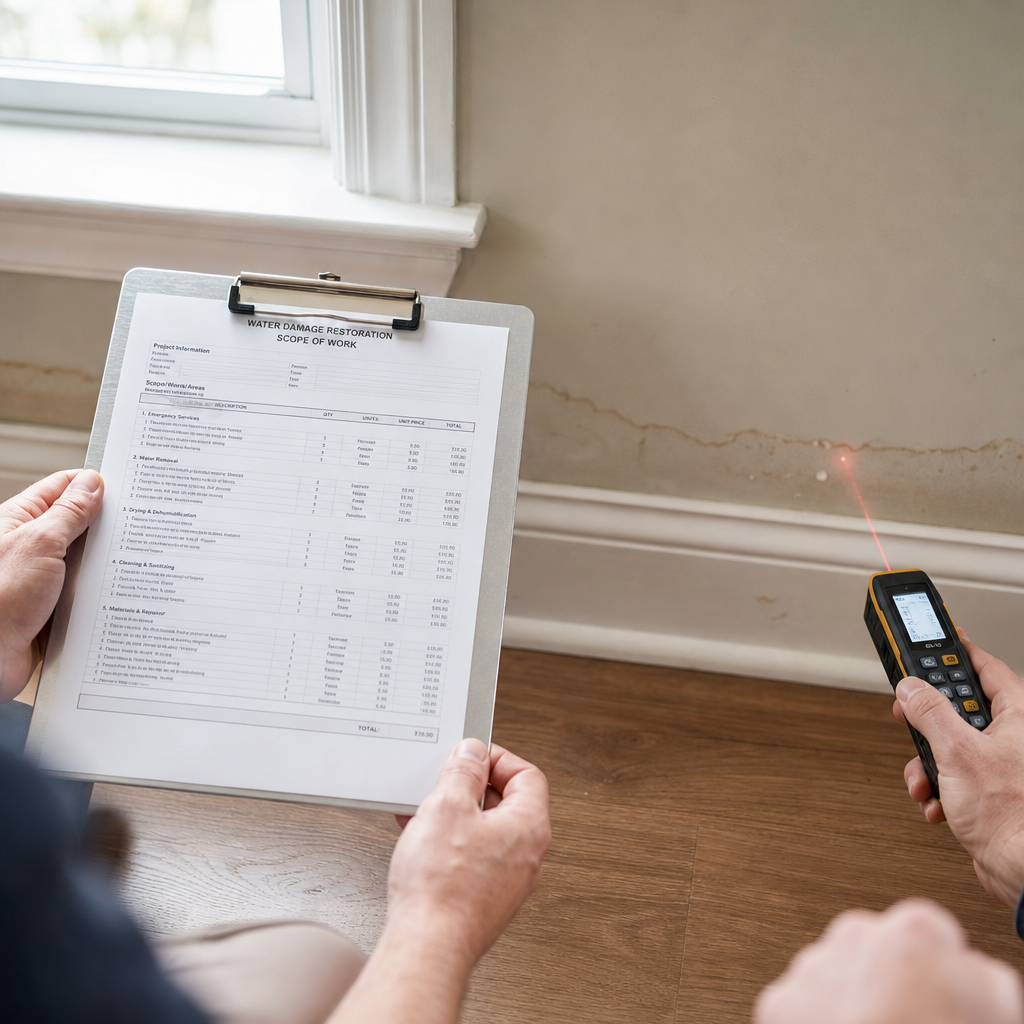
Notify your insurance carrier as soon as the emergency is stabilized. Stick strictly to verified facts when describing the incident, stating what occurred and what areas were affected.
Categorizing the Loss Accurately
Avoid speculative language about how long an issue has persisted. Provide the exact date and time the incident was discovered.
For standard property policies, you will receive a claim number and be assigned a claims representative or field adjuster. For NFIP flood claims, federal guidelines generally require submitting a signed, itemized Proof of Loss within 60 days of the incident date, unless an official extension is issued.[3]
Step 4: Walk the Property with the Adjuster and Compare Estimates
When the adjuster visits your property, accompany them through the affected areas and present the documentation gathered.
Reviewing the Scope of Work
Adjusters and contractors typically prepare itemized repair estimates detailing labor, materials, and equipment needed for remediation and repairs.
Compare the adjuster’s itemized repair estimate against your contractor’s scope of work. Areas of difference may include:
- Matching requirements for continuous flooring or surfaces.
- Allowances for necessary containment or air-filtration equipment.
- Allowances for equipment run-time.
- Insulation or structural cavity repairs.
If covered damage was omitted, your contractor can submit a supplemental request with supporting documentation to request additional review.
Step 5: Complete Repairs and Submit the Final Proof of Loss
Need water damage insurance claim process?
We’re available now - call for a fast, free estimate.
Once drying and repairs are completed, documentation, itemized invoices, and completion records are submitted to the insurer.
ACV vs. RCV Payouts
Claim payment structure depends on the specific terms of the policy. The provided research does not establish a universal two-payment process, as payment schedules, actual cash value deductions, and replacement cost disbursements vary by insurer and policy type.
If your claim was filed under the NFIP, submit your completed, signed Proof of Loss alongside receipts within the required window. If parts of an NFIP claim are denied, policyholders have the right to file an administrative appeal with FEMA within 60 days of the denial notice.
Evaluating Structural Elements by Material Type
Different building components may require inspection following water exposure:
Drywall, Plaster, and Insulation
Wall assemblies and insulation affected by water should be inspected to determine the extent of moisture absorption and whether repair or replacement is appropriate under policy guidelines.
Hardwood, Engineered Flooring, and Subfloors
As experts at Floodline Restoration Co. point out, flooring and underlying subfloors should be evaluated to assess whether water has affected multiple layers and whether materials can be restored or need replacement.
Basements, Utility Rooms, and Crawl Spaces
When utility or below-grade areas take on water, mechanical, electrical, and HVAC components should be inspected for safety and proper operation.
What Are Your Out-of-Pocket Costs?
Direct costs during a covered water loss depend on your specific policy terms. Deductibles and potential sub-limits (such as limits on mold remediation or water backup) are policy-dependent examples that require verification from your actual policy declarations and contract.
Prompt mitigation and thorough documentation can help manage repair scopes and keep claims aligned with applicable policy terms.
Frequently Asked Questions
Should I call a restoration company before or after calling my insurance company?
You can contact an emergency restoration company and your insurance carrier promptly when a loss occurs. Restoration contractors can assist with emergency mitigation steps to help prevent further damage, while notifying your insurer starts the formal claim process.
How long does a water damage insurance claim take to settle?
There is no universal settlement timeframe. Timing depends on the policy, damage complexity, documentation, adjuster investigation, and whether repairs require multiple payments.
What types of water damage are typically covered by homeowner’s insurance?
Depending on the policy, sudden and accidental plumbing leaks or burst pipes may be covered. Standard homeowners policies generally exclude flood damage, and sewer or sump-pump backup may require a separate endorsement.
What happens if my insurance company denies my claim?
Review the formal denial letter to see which specific policy provision or exclusion was cited. If the denial involves disputed damage, you can submit documentation, invoices, or contractor estimates for further review. For flood claims denied under the NFIP, you have 60 days from the date of the denial letter to file a formal appeal with FEMA.
Advertisement: For emergency water extraction, thermal imaging inspection, and insurance claim documentation across Long Island City and Queens, contact Floodline Restoration Co.
Need water damage insurance claim process?
We’re available now - call for a fast, free estimate.
Sources
- [PDF] national flood insurance program – media toolkit – Agents Floodsmart – agents.floodsmart.gov (2024)
- flooded (a report by fema) – agents.floodsmart.gov (2023)
- NFIP Claims Manual – fema.gov
- [PDF] Extreme Weather and Property Insurance: – NAIC – content.naic.org (2019)
Related reading: Burst Pipe Cleanup – Call Now-10% Off – On-Site in 60 Minutes – Free Estimate
Frequently Asked Questions
What should I do if hidden water damage is discovered after the adjuster's initial estimate?
If additional damage is found inside wall cavities or subflooring during remediation, your contractor can file a supplemental claim with your insurer. Floodline Restoration Co. helps expedite this by providing itemized scope revisions, thermal imaging records, and photos that substantiate the additional required repairs.
How does professional moisture mapping protect my water damage insurance payout?
Moisture mapping and thermal imaging provide indisputable baseline data showing where moisture traveled behind finished surfaces. Floodline Restoration Co. uses these precise readings to justify structural drying runtimes and material removal, preventing adjusters from undervaluing hidden structural damage.
Can my insurance claim be denied if I start emergency water extraction before the adjuster inspects?
No, because policies require policyholders to fulfill a duty to mitigate and prevent secondary damage like mold or structural rot. Floodline Restoration Co. captures thorough pre-mitigation photos and moisture logs immediately upon arrival so your emergency extraction costs are fully documented for your adjuster.
About the author
 |
Sarah Miller Sarah Miller is a certified water damage restoration specialist with over eight years of experience working closely with property owners in the New York metropolitan area. She holds a B.S. in Construction Management from Pratt Institute and specializes in transparent cost estimation and structural mitigation protocols. Sarah is passionate about helping clients navigate complex insurance claims and restoring their properties efficiently. |
Water damage, flood, or mold emergency?
We’re available now - call for a fast, free estimate.
Call Now - Free Estimate