
Quick Summary
Professional mold remediation in Long Island City NY requires strict compliance with New York licensing laws, precise moisture diagnostics, and containment-first protocols to protect multi-unit and commercial properties. Floodline Restoration Co. provides specialized local remediation services by utilizing infrared thermal imaging, HEPA-filtered containment barriers, and controlled structural drying to eliminate mold hazards safely. Property owners will understand regulatory assessment mandates, realistic project costs, and how to connect with Floodline Restoration Co. to schedule an evaluation and obtain a formal scope of work.
Mold Remediation Long Island City NY: Response and Project Guide
When you need mold remediation in Long Island City NY, addressing moisture and containing affected areas are key priorities. Response times vary by provider, and no authoritative source establishes a standard Long Island City response time. Confirm availability directly. Regarding costs, $1,314 to $3,783 is a third-party NYC estimate for typical partial jobs, not an average or guaranteed Long Island City price; larger projects may cost substantially more.[4]
A common mistake property owners make is attempting uncontained removal of mold-damaged materials, which can spread dust and debris. Safe remediation projects focus on controlling moisture sources, assessment, and establishing containment where appropriate. See also Water Damage Restoration in Long Island City | 10% Off & Free Estimate | Same-Day Service.
Professional services, such as those provided by Floodline Restoration Co., typically include moisture control, assessment, remediation, containment where appropriate, and post-remediation verification. Contact a licensed professional to schedule an evaluation and establish a scope of work based on project conditions.
What You Need to Know: The Long Island City Mold Guide
Professional mold remediation involves identifying moisture problems, planning appropriate containment when necessary, and remediating affected materials according to applicable guidelines and project plans.
Key Takeaways for LIC Property Owners
- Containment Where Appropriate: Isolation barriers and HEPA filtration may be used depending on the project plan to prevent debris and particles from spreading into adjacent spaces.
- New York Licensing Laws: Projects over 10 square feet in covered NYC buildings, including buildings with 10 or more dwelling units or qualifying non-residential properties, generally require appropriately licensed and independent mold assessors and remediators. The assessor and remediator must be independent of one another. New York law does not require mold remediation solely because mold is present; requirements depend on the affected area, property type, building size, and whether professional services are used.
- Insurance Records: Coverage may apply when mold results from a covered event, but exclusions, limits, and documentation requirements vary by policy. Review the policy and contact the insurer.
Checklist Before Work Starts
- Licensed Assessment: Where required or appropriate, engage a licensed mold assessor to evaluate the space and provide a formal remediation plan.
- Clear Access: Ensure clear physical access to suspected areas where water intrusion or leaks may be occurring.
- Regulatory Review: Check compliance with applicable New York State and NYC regulations for covered residential or commercial properties.
New York State identifies water infiltration and mold as housing-related hazards, and recommends controlling moisture and water problems to help prevent mold growth. In citywide data from the 2014 NYC Housing and Vacancy Survey, nearly 17% of New York City households reported active water leaks, underscoring how common building moisture issues are across the city.[1]
Step 1: Moisture Assessment and Diagnostic Tools
According to professionals like Floodline Restoration Co., remediation projects begin with assessing moisture sources and evaluating the extent of affected materials before disturbing building assemblies.
Detecting Moisture Issues
Technicians and assessors evaluate spaces using diagnostic tools as appropriate for the property:
- Infrared Thermal Cameras: Help detect temperature anomalies that may indicate trapped moisture.
- Moisture Meters: Provide comparative moisture readings across various building materials.
New York Mold Assessment Regulations
Under New York regulations, projects over 10 square feet in covered NYC buildings, including buildings with 10 or more dwelling units or qualifying non-residential properties, generally require appropriately licensed and independent mold assessors and remediators. An independent licensed mold assessor inspects the property, develops a remediation plan, and performs post-remediation assessment and any required verification or certification under the applicable project requirements. New York law does not require mold remediation solely because mold is present, and requirements depend on the affected area, property type, building size, and whether professional services are used.[2]
Step 2: Containment and Airflow Controls
Need mold remediation Long Island City NY?
We’re available now - call for a fast, free estimate.
When specified by the project plan, containment barriers help isolate the work area to manage dust and particle distribution during remediation.
Containment Measures
Depending on the scope and licensed remediation plan, containment strategies may include:
- Isolating work areas with plastic sheeting and sealing relevant openings where necessary.
- Using HEPA-filtered air filtration devices to manage airflow within the containment zone.
Multi-Unit Property Considerations
In multi-unit properties, containment and airflow controls may be established to help protect adjacent living areas and corridors during remediation work, as outlined in the project plan.
Step 3: Remediation of Affected Porous Materials
Porous materials with extensive mold growth may require removal and disposal if they cannot be effectively cleaned, while structural elements are evaluated according to the remediation plan developed with specialists like Floodline Restoration Co.
Removal Protocols
Depending on the specific remediation plan, technicians may employ methods such as:
- Careful removal of damaged materials to minimize dust dispersion.
- Bagging and sealing removed debris before transport out of the work area.
Evaluating Materials
Porous items such as saturated drywall or ceiling tiles often require removal, whereas semi-porous and non-porous structural framing may be cleaned and dried depending on the project assessment.
Step 4: HVAC and Mechanical Systems
HVAC components and mechanical pathways within the work area are evaluated and isolated as necessary during remediation.
Protecting Air Systems
Remediation plans may specify isolating registers, diffusers, and local mechanical units within the work zone to prevent dust from entering mechanical systems during active work.
Step 5: Cleaning and Remediation Methods
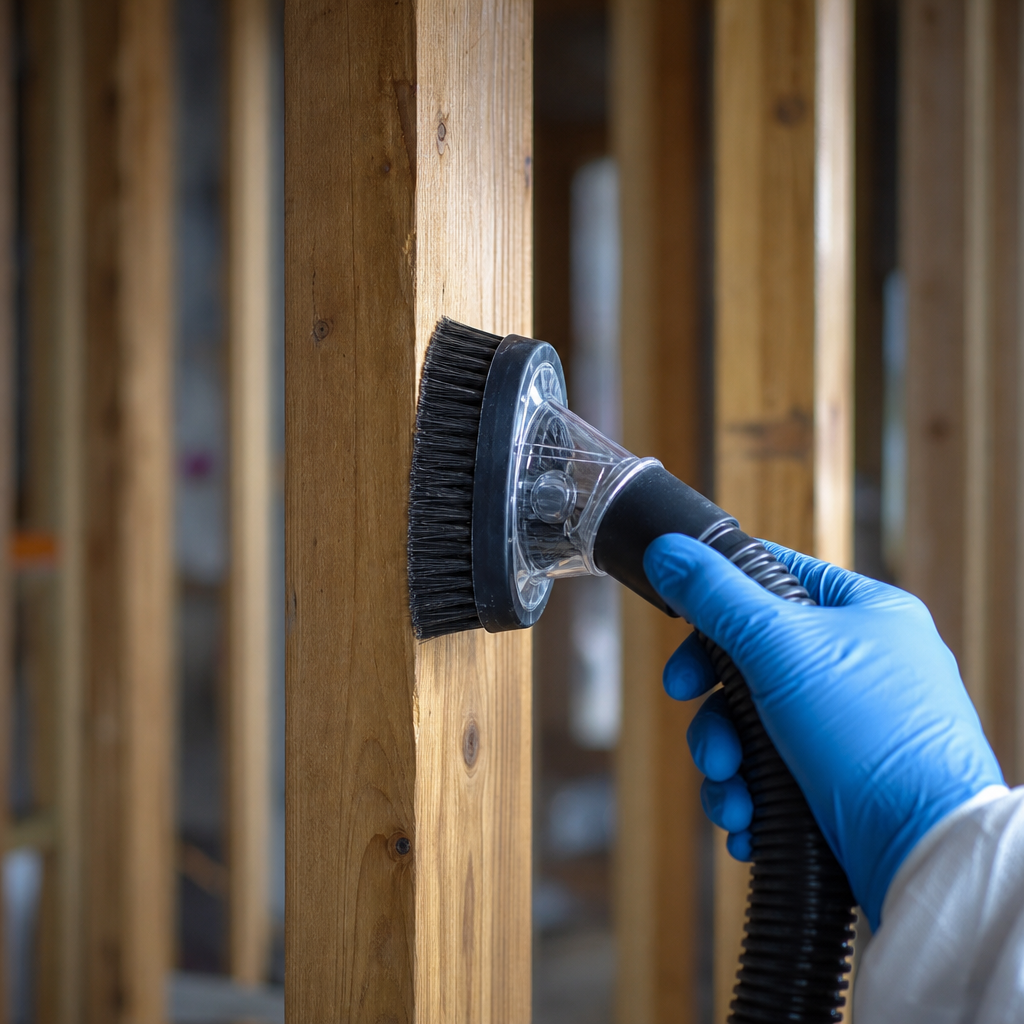
Exposed framing and structural surfaces are cleaned using methods outlined in the remediation plan.
Surface Cleaning
Depending on project requirements, cleaning methods may include:
- Physical cleaning and HEPA vacuuming of exposed framing and surfaces to remove debris.
- Application of cleaning solutions or treatments as specified in the remediation plan.
Step 6: Structural Drying and Post-Remediation Verification
Need mold remediation Long Island City NY?
We’re available now - call for a fast, free estimate.
Drying damp structural elements is critical to resolving moisture problems and preventing recurring mold growth.
Dehumidification and Drying
Remediation contractors such as Floodline Restoration Co. use dehumidification and air movement equipment as needed to facilitate drying, monitoring moisture conditions until appropriate drying goals are achieved.
Post-Remediation Assessment
- Post-Remediation Assessment: An independent licensed mold assessor conducts a post-remediation assessment and any required verification or certification under the applicable project requirements.
- Containment Removal: Once verification is complete, containment materials are removed and the area is prepared for any necessary repairs.
Remediation Considerations Across Building Types
Remediation approaches in Long Island City depend on the specific construction and mechanical design of each property, following a customized remediation plan.
| Building Type | Potential Moisture Factors | Remediation Considerations |
|---|---|---|
| Masonry and Timber Buildings | Exterior moisture intrusion or plumbing leaks | Moisture assessment, structural drying, and targeted cleaning |
| Modern Multi-Unit Buildings | Mechanical condensation, plumbing lines, or envelope leaks | Containment where appropriate, localized drying, and airflow management |
What Does Mold Remediation in Long Island City Cost?
Costs depend on the affected area, the moisture source, containment needs, and the scope of work required. A third-party NYC estimate for typical partial remediation jobs ranges between $1,314 and $3,783, though this is not a guaranteed Long Island City price; larger projects may cost substantially more.
Working With Property Insurance
Coverage may apply when mold results from a covered event, but exclusions, limits, and documentation requirements vary by policy. Review the policy and contact the insurer.
Frequently Asked Questions
How much does mold remediation cost in Long Island City NY?
A third-party NYC estimate for typical partial jobs ranges from $1,314 to $3,783, but this is not a guaranteed price for Long Island City. Larger projects may cost substantially more depending on the total area, containment requirements, and structural repairs.
How quickly can a mold remediation team respond in Long Island City?
Response times vary by provider, and no authoritative source establishes a standard Long Island City response time. Confirm availability directly.
Is a separate mold assessment required by law in New York?
Projects over 10 square feet in covered NYC buildings, including buildings with 10 or more dwelling units or qualifying non-residential properties, generally require appropriately licensed and independent mold assessors and remediators. An independent licensed mold assessor conducts the assessment, develops the plan, and performs post-remediation assessment and any required verification or certification under the applicable project requirements. New York law does not require mold remediation solely because mold is present; requirements depend on the affected area, property type, building size, and whether professional services are used.[3]
Does commercial property or homeowners insurance cover mold removal in NYC?
Coverage may apply when mold results from a covered event, but exclusions, limits, and documentation requirements vary by policy. Review the policy and contact the insurer.
How do professionals find hidden moisture and mold behind walls?
Professionals, including the team at Floodline Restoration Co., may use tools such as infrared thermal imaging and moisture meters to locate damp areas and evaluate moisture levels in building materials.
What certifications should a mold contractor have in New York?
In New York State, mold professionals working on regulated projects must hold appropriate licenses issued by the New York State Department of Labor, with assessors and remediators operating independently.[5]
Need mold remediation Long Island City NY?
We’re available now - call for a fast, free estimate.
Sources
- Housing maintenance data for NYC - Environment & Health Data Portal – a816-dohbesp.nyc.gov (2026)
- Data on asthma triggers in NYC - Environment & Health Data Portal – a816-dohbesp.nyc.gov (2026)
- Proposed Consolidated Plan 2021 – 2025 – nyc.gov (2025)
- Data index – Environment & Health – a816-dohbesp.nyc.gov (2023)
- NYS Tox Mold Task Force Final Report, December 2010 – health.ny.gov (2010)
Related reading: Water Damage Insurance Claim – Call Now-10% Off – Same-Day Service – Free Estimate
Related reading: Water Damage Insurance Claim Process – Call Now-10% Off – Same-Day Service – Free Estimate
Related reading: Can You Clean Black Mold Yourself – 10% Off & Free Estimate – Same-Day Service
Frequently Asked Questions
How does mold remediation differ between Long Island City industrial lofts and modern high-rises?
Converted industrial lofts often feature heavy timber and historic masonry requiring specialized structural drying, while modern LIC high-rises typically face HVAC condensation issues requiring isolated corridor containment. Floodline Restoration Co. tailors IICRC AMRT protocols to each structural profile to prevent cross-contamination across shared ventilation and multi-unit living spaces.
What happens during post-remediation verification in New York City buildings?
An independent NYS-licensed mold assessor conducts a visual inspection and clearance evaluation once remediation is complete to verify all moisture goals and removal criteria were met. After the assessor confirms the space passes clearance, Floodline Restoration Co. safely dismantles the HEPA-filtered containment barriers and prepares the property for final reconstruction.
How do I get an immediate inspection and written scope of work for mold in LIC?
Property owners can contact the Floodline Restoration Co. 24/7 live dispatch team to schedule a prompt visual inspection utilizing moisture meters and thermal imaging. Following the diagnostic evaluation, our team delivers a detailed written scope of work aligned with New York State mold compliance standards.
About the author
 |
Sarah Miller Sarah Miller is a certified water damage restoration specialist with over eight years of experience working closely with property owners in the New York metropolitan area. She holds a B.S. in Construction Management from Pratt Institute and specializes in transparent cost estimation and structural mitigation protocols. Sarah is passionate about helping clients navigate complex insurance claims and restoring their properties efficiently. |
Water damage, flood, or mold emergency?
We’re available now - call for a fast, free estimate.
Call Now - Free Estimate