
Quick Summary
Learning how to properly clean black mold is critical for property owners to protect indoor air quality and prevent cross-contaminating unaffected rooms. While small patches on hard surfaces can be washed using proper personal protective equipment, Floodline Restoration Co. emphasizes that contaminated porous materials like drywall require physical removal and moisture correction rather than bleach. After reading this guide, homeowners will understand the limits of DIY remediation and know when to schedule a free visual inspection and professional moisture assessment for extensive structural contamination.
Clean Black Mold: Safe Removal Guide
Discovering dark fungal patches along your baseboards, bathroom ceiling, or basement walls is always unsettling. While finding dark mold often causes immediate alarm, taking the right steps to clean black mold comes down to two practical priorities: controlling the underlying moisture and handling the contaminated materials without spreading spores through the rest of your home.[2]
Indoor dampness is estimated to affect approximately 10% to 50% of indoor environments in Europe, North America, Australia, India, and Japan. The WHO notes that living or working in damp, moldy spaces increases the risk of respiratory issues, asthma exacerbations, allergic rhinitis, and general hypersensitivity. Public health guidance focuses on removing the growth and fixing the moisture problem regardless of the mold’s color, because exposure risks relate directly to overall dampness, concentration, and individual sensitivity rather than color alone.[1] See also Black Mold Removal – 10% Off & Free Estimate – Same-Day Service.
The Science of Cleaning Mold: Considerations with Bleach
When property owners spot dark mold on a wall, their first instinct is often to spray it down with household bleach. Bleach may be used correctly on some hard, nonporous surfaces, but it does not permanently prevent recurrence and should not substitute for moisture control or appropriate removal of contaminated porous materials.
Applying bleach to porous materials like drywall or untreated wood framing does not solve the underlying dampness problem. As emphasized by specialists like Floodline Restoration Co., proper mold management focuses on cleaning washable surfaces with appropriate solutions, fixing the moisture source, or physically removing contaminated porous materials.[3]
Immediate Safety Rules and Containment Protocols
Before scrubbing or disturbing any moldy surface, take basic steps to protect yourself and prevent cross-contamination across unaffected rooms.
Required Personal Protective Equipment (PPE)
Disturbing dry mold sends spores into the air. When evaluating or cleaning contaminated materials, use proper protective equipment:
- An N95 respirator, protective goggles, and suitable gloves are the minimum equipment supported for cleanup, while extensive removal may require a half-face or full-face respirator.
- Protective clothing or coveralls that can be washed or discarded immediately after the job.
When You Can DIY vs. When to Call a Professional
Cleanup decisions depend on the extent and location of the growth:
- DIY Cleanup: Small surface mold on hard or semi-porous surfaces can generally be handled by a homeowner using proper PPE and ventilation.
- Professional Mold Remediation: Professional help is warranted for extensive growth, HVAC contamination, major water damage, or substantial moldy drywall removal.
Guidelines for Cleaning Hard Surfaces vs. Porous Materials
Different building components require completely different cleanup strategies. Using the wrong technique on porous substrates will leave hidden contamination behind.
| Material Category | Recommended Cleaning Approach | Key Considerations |
|---|---|---|
| Hard, Nonporous Surfaces (Tile, Metal, Porcelain, Glass) | Wash with detergent and water first, scrub with a brush, rinse, and dry completely. Bleach may be used correctly on some hard, nonporous surfaces. | Never mix bleach with ammonia or other household chemicals. Ensure the room is fully ventilated during and after cleaning. Bleach does not permanently prevent recurrence. |
| Semi-Porous Surfaces (Structural Framing Lumber, Solid Hardwood) | Clean hard surfaces with detergent and water first, and dry thoroughly. | Vinegar is not established as a permanent mold-removal solution. Focus on fixing moisture sources and drying materials thoroughly. |
| Porous Materials (Drywall, Batt Insulation, Carpet, Ceiling Tiles) | Physical removal and disposal. Mold-contaminated drywall and insulation affected by floodwater or sewage should be removed and discarded. | Porous items often cannot be fully cleaned once mold penetrates the material. Bag materials in heavy plastic before carrying them through the home. |
Component Guide: Drywall, Framing, and Basements
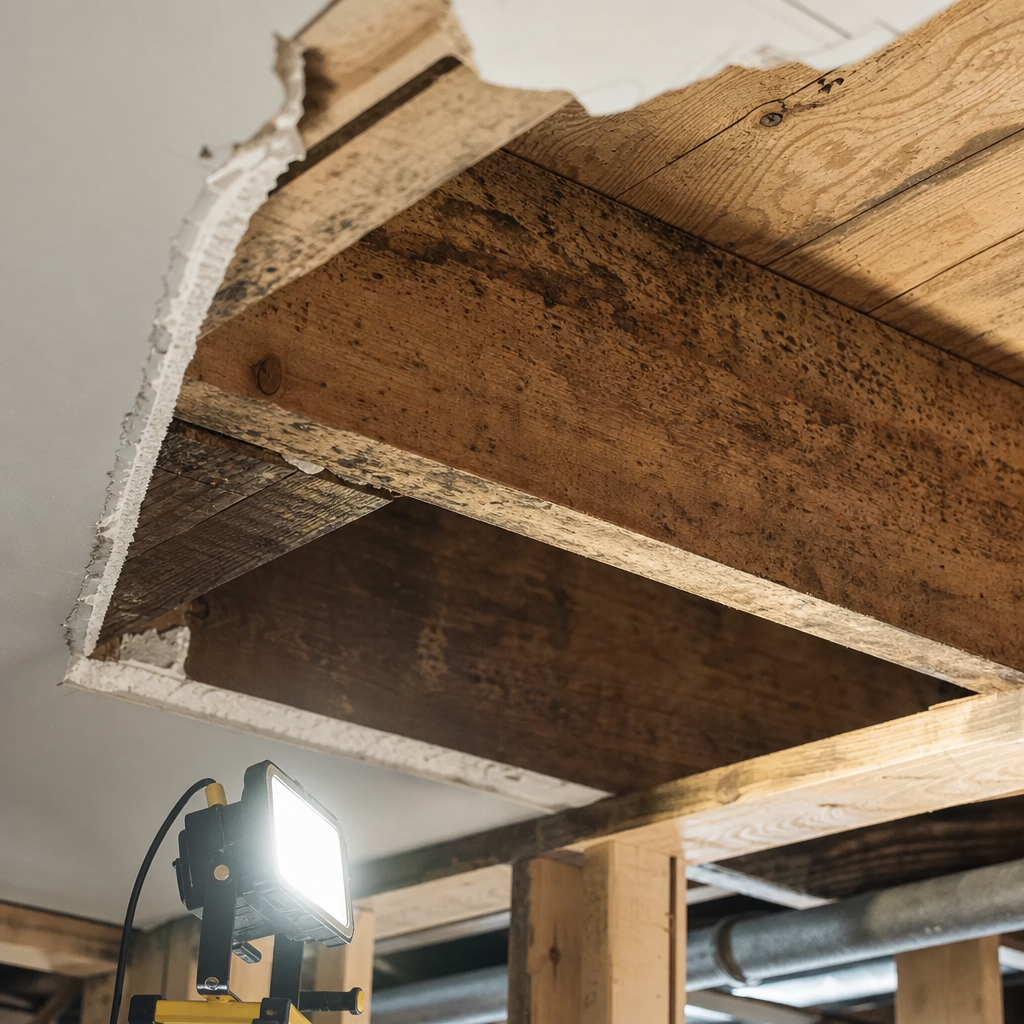
Every part of a building reacts differently to water intrusion. Here is how to handle specific structural components safely.
Drywall and Ceiling Assemblies
Gypsum board is an ideal food source for mold because the paper backing contains cellulose, which fungi consume when damp. If drywall becomes wet from behind (such as from a leaking pipe or roof leak), surface cleaning is insufficient. Mold-contaminated drywall and insulation should be removed, discarded, and replaced.[4]
Structural Framing and Subfloors
Unlike drywall, structural studs and joists rarely need replacement unless structural integrity is compromised. To clean wood framing:
- HEPA Vacuum: Vacuum the framing with a HEPA-filtered vacuum to remove loose surface spores before applying liquids.
- Scrub: Clean the wood with a mild detergent and water solution.
- Dry Thoroughly: Fix the underlying moisture source and ensure materials are dried thoroughly with adequate ventilation and dehumidification.
Basements and Crawl Spaces
Basements are particularly vulnerable to chronic dampness from foundation seepage, humidity, and plumbing failures. If you are dealing with standing water, fast basement water removal, such as that provided by Floodline Restoration Co., is your top priority. Mold can establish colonies on damp baseboards and cardboard storage boxes. When a pipe bursts, shutting off the main water valve immediately and extracting water limits the total surface area that fungi can colonize.[5]
How to Know if Mold Has Spread Inside Walls
Visible surface patches are frequently just the visible edge of a larger problem inside the wall cavity. Common signs of mold in a house include:
- Persistent Musty Odors: A distinct, earthy, or damp smell that lingers even after surfaces are cleaned usually indicates active microbial growth inside wall cavities, under subflooring, or inside ducting.
- Discoloration and Staining: Yellowish water rings, bubbling paint, or peeling wallpaper often show where water travelled behind the wallboard.
- Warped Baseboards or Soft Drywall: Baseboards that pull away from the wall or drywall that feels spongy when pressed indicate prolonged water saturation.
Professional Remediation and Considerations
Professional remediation services, such as those offered by Floodline Restoration Co., may be necessary when damage exceeds what can safely be addressed with basic household cleanup.
When Professional Help Is Warranted
Professional remediation is warranted in situations involving:
- Extensive mold growth across large structural areas.
- Contamination in HVAC systems and ductwork.
- Major water damage from floods, plumbing failures, or sewage backups.
- Substantial removal of contaminated drywall and structural materials.
Remediation Costs
Specific remediation cost ranges are unsupported estimates that require separate, location-specific evidence based on the scope of work, structural repairs, and local labor rates.
Frequently Asked Questions
Can I clean black mold myself or do I need a professional?
Small surface mold on hard surfaces may be handled by a homeowner with proper PPE. However, professional help is warranted for extensive growth, HVAC contamination, major water damage, or substantial drywall removal.
Does bleach or vinegar kill black mold permanently?
Bleach may be used correctly on some hard, nonporous surfaces, but it does not permanently prevent recurrence and should not substitute for moisture control or appropriate removal of contaminated porous materials. Vinegar is not established as a permanent mold-removal solution. Clean hard surfaces with detergent and water first, and fix the underlying moisture problem.
What safety gear is required when cleaning black mold?
An N95 respirator, protective goggles, and suitable gloves are the minimum equipment supported for cleanup, while extensive removal may require a half-face or full-face respirator.
How do you safely remove black mold from drywall and wood?
Mold-contaminated drywall and insulation affected by floodwater, sewage, or persistent leaks should be removed and discarded. For structural wood, clean the surface with detergent and water, fix any moisture sources, and dry the materials thoroughly.
How much does professional black mold remediation cost?
Remediation cost figures are unsupported estimates that require separate, location-specific evidence depending on the extent of the damage and specific repair needs.
Sources
- Prevalence, Risk Factors and Impacts Related to Mould … – PMC – pmc.ncbi.nlm.nih.gov (2022)
- [PDF] Indoor dampness and mould health effects – CDC Stacks – stacks.cdc.gov (2007)
- Exposure to residential mold and dampness and the … – PubMed – pubmed.ncbi.nlm.nih.gov
- WHO publishes first indoor air quality guidelines on dampness and … – who.int (2009)
- Children living in homes with problems of damp: fact sheet No. 3.5, May 2007 – iris.who.int (2007)
Related reading: Homeowners Insurance Flood Coverage | Call Now-10% Off | Same-Day Service | Free Estimate
Related reading: Mold Remediation Cost | Call Now-10% Off | Same-Day Service | Free Estimate
Related reading: Flooded Basement Cleanup | 10% Off & Free Estimate | Same-Day Service
Frequently Asked Questions
How can I tell if black mold has spread behind my walls without tearing down drywall?
Persistent musty odors, warped baseboards, and peeling paint often indicate hidden microbial growth behind wall assemblies. To confirm contamination without causing unnecessary demolition, schedule a free visual inspection and professional moisture assessment with Floodline Restoration Co. to accurately locate hidden dampness.
Why shouldn't I use a standard household vacuum to clean mold from structural framing?
Standard household vacuums lack true HEPA filtration and will exhaust microscopic mold spores directly back into your indoor air, causing widespread cross-contamination. Certified remediation protocols require HEPA-filtered vacuums to trap dry surface spores securely before washing and drying structural wood.
What should I do immediately if I suspect black mold is inside my HVAC system?
Shut off your heating and cooling system immediately to prevent forced air from blowing mold spores throughout unaffected rooms. Because ductwork contamination requires specialized negative-air containment, contact Floodline Restoration Co. to evaluate the ventilation system and safely remediate the growth.
About the author
 |
David Harrison David is a certified property restoration specialist with over 12 years of experience in emergency mitigation and structural drying. He holds a degree in Construction Management from the New York Institute of Technology and is an IICRC-certified Master Water Restorer. David specializes in translating complex restoration protocols into actionable advice for property owners navigating unexpected disasters. |
Water damage, flood, or mold emergency?
We’re available now - call for a fast, free estimate.
Call Now - Free Estimate