
Quick Summary
Navigating a fire damage insurance claim requires immediate property stabilization, meticulous documentation, and strategic coordination to secure a fair settlement for costly structural and contents losses. Partnering with an experienced disaster recovery specialist like Floodline Restoration Co. streamlines the process through professional site mitigation, itemized room-by-room damage logging, and direct adjuster billing. Property owners will learn how to prevent secondary soot and water damage, navigate policy coverage types like RCV and ACV, and effectively manage repair timelines to maximize their insurance payouts.
“`html
Fire Damage Insurance Claim: Maximize Payout Fast
Managing a fire damage insurance claim effectively involves acting promptly to stabilize the structure, building a detailed room-by-room inventory, and communicating with your insurance carrier regarding scope agreements before major reconstruction starts. Fire claims represent some of the highest-dollar property losses in the country, and adjusters examine documentation closely.[2]
When municipal firefighting efforts douse a blaze, water combines with soot, which can lead to additional damage and secondary mold growth if left unaddressed. Property insurance policies typically expect policyholders to take reasonable measures to protect the property from further damage. Taking prompt, documented steps to stabilize your home helps protect your property and supports your claim documentation.[3] See also Water Damage Restoration Long Island City | Call Now-10% Off | Same-Day Service | Free Estimate.
Step 0: What You Need and Quick Claim Essentials
To start a fire claim, contact your carrier as soon as practical, protect the building against weather and unauthorized entry where safe to do so, catalog damaged items, and prepare for the adjuster walkthrough. Because every loss involves distinct structural and contents challenges, settlement timelines vary. Clear documentation and professional guidance can help keep the process organized.
Immediate Action Checklist and Required Documents
Keep a dedicated physical folder and digital drive for your claim records. Gather these records right away:
- Policy Declaration Page: Identifies your policy limits for structural damage (Coverage A), personal contents (Coverage C), and loss of use / Additional Living Expenses (Coverage D), along with your deductible.
- Official Fire Incident Report: Issued by the local fire department, confirming the date, time, and documented details of the blaze.
- Itemized Damage Inventory: Photos, videos, and descriptions of building elements and personal property taken prior to cleanup or debris removal.
- Living Expense Receipts: Receipts for emergency lodging, meals, and temporary rentals that may be eligible for Additional Living Expenses (ALE) reimbursement.
Key Claim Statistics and Considerations
According to the Insurance Information Institute, approximately one in 425 insured homes files a fire and lightning property damage claim each year, and overall, about one in 18 insured homes experiences a property claim annually. When fire strikes, claims average $83,991 per incident, ranking as the most expensive property loss category in homeowners insurance. Because loss payouts are substantial, insurance carriers require documentation for claimed damages. Property owners often consult local restoration professionals for emergency stabilization, water extraction, and structural drying.[1]
Step 1: Secure the Property and Prevent Further Damage
Property policies generally require policyholders to take reasonable steps to mitigate secondary damage after an incident. Failing to protect an exposed structure from weather or leaving standing water unaddressed may lead to complications during the claim process.
Preventing Secondary Water and Soot Damage
Smoke particles carry chemical residues that can cause staining or corrosion when mixed with moisture. Promptly removing standing water and addressing high humidity helps prevent avoidable deterioration to salvageable surfaces.
General Guidance: Emergency Board-Up and Stabilization
The following are common stabilization practices recommended by industry professionals:
- Securing the building envelope: Covering broken windows, doors, or roof openings with plywood or tarps to deter unauthorized entry and keep out weather.
- Extracting suppression water: Removing standing water from floors and basements to reduce moisture absorption in building materials.
- Deploying drying equipment: Utilizing commercial dehumidifiers and air movers or filtration units to lower ambient moisture levels.
Local emergency restoration providers like Floodline Restoration Co. often perform these stabilization services and provide initial documentation of the site conditions for your records.
Step 2: Document Structural Components and Damaged Contents
Need fire damage insurance claim?
We’re available now - call for a fast, free estimate.
Before major cleanup or demolition begins, build a clear visual record of the damage. Use room-by-room photos and videos to provide objective documentation for your adjuster.
Structural Framing, Ceilings, and Drywall
Fire suppression water can collect in ceiling cavities, wall assemblies, and under subfloors. Moisture meters and thermal imaging are commonly used by professionals as diagnostic tools to identify damp areas behind finished surfaces so that necessary drying or material removal can be evaluated by the carrier.
HVAC and Air Quality Considerations
Forced-air ventilation systems can distribute particulate matter and soot to areas away from the immediate fire source. Checking registers, return vents, and ductwork helps determine whether professional cleaning, sealing, or replacement may be necessary.
Contents: Inventorying Personal Belongings
Separate personal property into restorable items and non-salvageable goods. Document brand names, model numbers, approximate age, and estimated replacement costs for items included on your personal property inventory list.
Step 3: File the Claim and Understand Your Coverage
Contact your insurance carrier’s claims department once everyone is safe. Provide your policy details, date of loss, and an initial description of the incident. You can also inquire about emergency advance funds if you have immediate out-of-pocket needs.[5]
Homeowners Coverage and Additional Living Expenses (ALE)
Standard homeowners insurance typically covers the house, personal belongings, and additional living expenses, subject to policy limits and deductibles:[4]
- Dwelling and Structures (Coverage A): Helps pay for repairs or rebuilding of the physical structure of your home.
- Personal Property (Coverage C): Covers repair or replacement costs for damaged personal items up to stated policy limits.
- Additional Living Expenses (Coverage D): Assists with reasonable increases in living costs – such as temporary lodging and meals – if your home is uninhabitable during repairs.
General Filing Considerations
Avoid signing final settlement releases while emergency mitigation and initial damage assessments are ongoing, as hidden damage or smoke odors may require supplemental review. Clear communication with your adjuster and contractor helps ensure all necessary repairs are documented.
Step 4: Walk Through the Inspection with the Insurance Adjuster
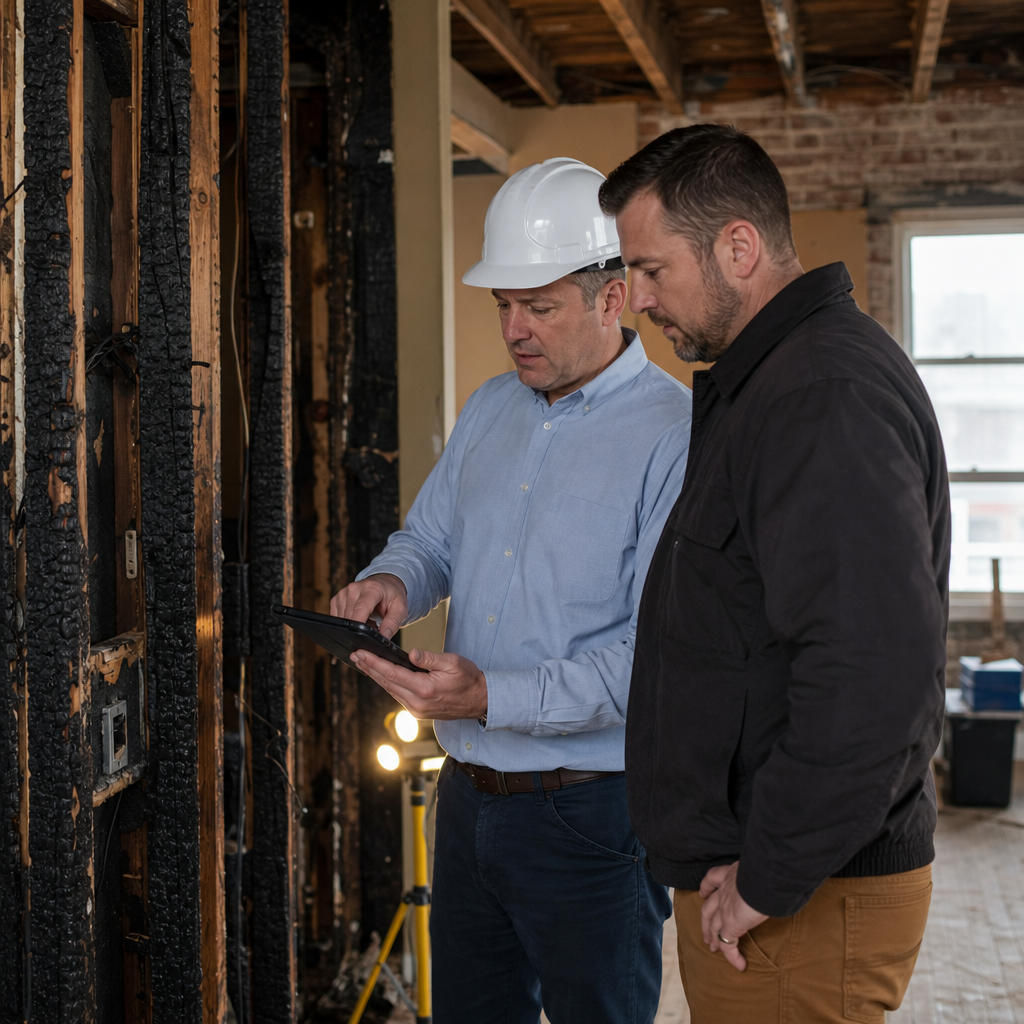
Walking the property with your insurance adjuster allows you to point out specific areas of damage. Having a contractor present can also help ensure structural conditions and drying needs are observed firsthand.
Estimating and Supplements
Insurers commonly use specialized estimating software to calculate repair costs. If hidden damage, code requirements, or additional repairs are discovered during the restoration process, contractors such as Floodline Restoration Co. can submit supplemental documentation to the carrier for review.
Understanding Actual Cash Value (ACV) and Replacement Cost Value (RCV)
Policy terms dictate how claim payouts are structured:
| Valuation Type | General Description |
|---|---|
| Actual Cash Value (ACV) | Generally reflects the replacement cost of an item or structure minus depreciation for age and wear. |
| Replacement Cost Value (RCV) | Covers the cost to repair or replace property at current market prices, subject to policy terms and limits. In policies with replacement cost coverage, withheld depreciation is commonly disbursed after repairs are completed or items are replaced. |
Step 5: Restoration and Billing Practices
Need fire damage insurance claim?
We’re available now - call for a fast, free estimate.
Restoration procedures and payment arrangements depend on your contractor and insurance policy terms.
General Guidance: Smoke Odor Neutralization and Reconstruction
Common industry methods for treating smoke and structural damage include:
- Air Treatment: Using specialized air filtration, hydroxyl units, or fogging equipment to address volatile organic compounds and smoke residues.
- Sealing and Encapsulation: Applying specialized sealers to structural framing to help lock in residual odors prior to closing walls.
- Reconstruction: Rebuilding framing, insulation, electrical systems, and drywall in accordance with applicable local building codes.
Billing and Payment Arrangements
Depending on the contractor, some firms offer direct billing arrangements where they submit estimates, logs, and invoices directly to the insurance carrier for review. Policyholders typically remain responsible for their policy deductible and any non-covered items.
What Does Fire Damage Insurance Restoration Cost?
Total restoration expenses depend on the square footage, burn severity, water volume used in suppression, and the specific materials affected. Standard homeowners insurance policies generally cover these costs within applicable policy limits, minus the deductible.
General Restoration Scope Categories
Restoration scopes generally fall into emergency stabilization, cleaning, and structural rebuilding:
| Loss Severity | Typical Scope Elements | General Process |
|---|---|---|
| Minor Smoke and Soot Loss | Surface cleaning, air filtration, minor painting, and localized deodorization. | Cleaning and surface treatment following site access. |
| Moderate Fire and Water Damage | Water extraction, structural drying, selective drywall removal, and contents cleaning. | Emergency stabilization followed by targeted structural repairs. |
| Major Structural Damage | Board-up, framing replacement, subfloor rebuilds, electrical repairs, and full interior finishes. | Emergency stabilization followed by phased structural reconstruction. |
Factors Influencing Final Claim Calculations
Final settlement amounts depend on policy limits, the scope of structural and contents damage, applicable endorsements (such as ordinance or law coverage), and the supporting documentation provided during the claim adjustment.
Frequently Asked Questions About Fire Damage Insurance Claims
How much does fire damage restoration cost?
Costs vary widely depending on the severity of the fire, the volume of water used during suppression, and the scope of structural repairs required. Under an approved homeowners claim, covered repairs are subject to your policy limits, terms, and deductible.
How long does a fire damage insurance claim take to settle?
Timelines depend on the complexity of the damage. Minor smoke claims may resolve within several weeks, whereas substantial structural losses requiring extensive rebuilding and permitting may take longer. Prompt communication and clear documentation help facilitate the review process.
What should you not do after a house fire?
Do not enter the property until fire officials confirm it is safe to do so. Avoid using impacted electrical systems or running the HVAC system without an inspection, as this can circulate soot particles throughout undamaged areas. Additionally, do not delay taking reasonable measures to protect the property from weather or further damage.
Can a restoration contractor bill insurance directly?
Many restoration contractors, including Floodline Restoration Co., work directly with insurance adjusters by providing estimates, drying records, and invoices. However, billing arrangements depend on the contractor’s business practices and carrier requirements, and policyholders remain responsible for applicable deductibles.
What does homeowners insurance cover after a fire?
Standard homeowners insurance typically covers the house (dwelling), personal belongings, and additional living expenses if the home is uninhabitable, subject to policy limits and deductibles.
“`
Need fire damage insurance claim?
We’re available now - call for a fast, free estimate.
Sources
- 2026 LexisNexis U.S. Home Insurance Trends Report – risk.lexisnexis.com (2026)
- 2026 LexisNexis® US Home Trends Report – risk.lexisnexis.com (2026)
- Facts + Statistics: Homeowners and renters insurance – iii.org (2024)
- Triple-I: Lightning Caused $1.04B in US Homeowners … – businesswire.com (2025)
- Home Insurance Statistics 2025 – guardianservice.com (2025)
Related reading: Flood Cleanup Cost | 10% Off & Free Estimate | Same-Day Service
Related reading: Water Mitigation Cost Per Square Foot – Call Now-10% Off – Same-Day Service – Free Estimate
Related reading: Commercial Water Mitigation – 10% Off & Free Estimate – Same-Day Service
Frequently Asked Questions
What happens if hidden fire damage is discovered after the adjuster's initial inspection?
If hidden smoke penetration, charred framing, or trapped moisture is uncovered during demolition, your contractor can file an insurance supplement for additional coverage. Floodline Restoration Co. documents these unseen structural issues using photo logs and diagnostic readings, submitting them directly to your adjuster to secure necessary payout adjustments.
How do you recover withheld depreciation on a fire damage claim?
Carriers typically disburse an initial Actual Cash Value (ACV) check and hold back depreciation until physical repairs or replacements take place. To collect the remaining Replacement Cost Value (RCV) balance, submit proof of purchase, itemized repair receipts, and your contractor's final certificate of completion before the policy deadline.
Can I request an immediate cash advance from my insurer after a house fire?
Yes, most insurers provide an emergency cash advance against your Additional Living Expenses (ALE) or personal contents coverage to fund immediate needs like temporary lodging, clothing, and meals. Be sure to retain all itemized receipts, as these advance funds will be deducted from your total claim settlement.
About the author
 |
Sarah Miller Sarah Miller is a certified water damage restoration specialist with over eight years of experience working closely with property owners in the New York metropolitan area. She holds a B.S. in Construction Management from Pratt Institute and specializes in transparent cost estimation and structural mitigation protocols. Sarah is passionate about helping clients navigate complex insurance claims and restoring their properties efficiently. |
Water damage, flood, or mold emergency?
We’re available now - call for a fast, free estimate.
Call Now - Free Estimate