
Quick Summary
A flooded basement presents immediate electrical hazards and severe structural risks that require controlled water extraction to prevent foundation wall collapse caused by external hydrostatic pressure. As a rapid-response specialist in Long Island City, Floodline Restoration Co. provides advanced basement flood cleanup through precision moisture mapping, industrial dehumidification, and full insurance claim coordination. Property owners can call Floodline Restoration Co. 24/7 for immediate emergency dispatch and schedule a free visual inspection to protect their foundation and safely restore their home.
Basement Flood Cleanup: Emergency Water Removal and Structural Drying
A flooded basement is an immediate emergency that threatens your home’s structural framing, indoor air quality, and electrical safety. Whether you are dealing with a sudden burst pipe in a finished basement, a failed sump pump during a storm, or sewer backup through floor drains, standing water requires fast, calculated extraction. Consumer cost data in 2026 places average flooded-basement cleanup around $4,000 with common ranges of roughly $2,000 to $7,000.[1]
Draining a flooded basement involves more than running a wet vacuum. In urban and coastal areas like New York City, particularly around low-lying sections of Queens, Brooklyn, Staten Island, and the Bronx, improper pumping can cause severe foundation damage. Surrounding waterlogged soil exerts heavy hydrostatic pressure against exterior foundation walls. If you pump out interior water too quickly, the loss of equalizing pressure can cause brick, fieldstone, or block walls to bow, crack, or collapse. Professional mitigation balances steady extraction with moisture mapping and controlled structural drying.[2]
Basement Flood Cleanup: Response Time, Costs, and What to Expect
Quick Summary: Professional basement flood cleanup follows key stages: hazard containment, water extraction balanced against external soil pressure, controlled removal of wet porous materials, sanitization, and dehumidification. Emergency agencies advise prompt extraction and drying following a flood event to mitigate mold growth and structural damage.[5]
Every hour water sits against drywall, subfloors, and porous masonry, it wicks deeper into the building assembly. Professional restoration contractors, including teams from Floodline Restoration Co., arrive with specialized extractors, dehumidifiers, and moisture meters to locate hidden moisture pockets behind finished walls before secondary damage takes hold.
Immediate Action Checklist for Flooded Basements
- Do not enter standing water with active power: Shut down power if you can do so safely from a dry location outside the flooded area. If the panel is inaccessible or submerged, contact your utility provider.
- Call a certified restoration contractor: Request a dispatch team equipped with extraction equipment, commercial dehumidifiers, and moisture meters.
- Document damage for insurance: Take clear photos and videos showing water lines on walls, submerged mechanicals, and damaged belongings before cleanout begins.
- Stop the water source if possible: If the flood originates from an interior supply line, shut off the main water valve if safely accessible.
Key Factors Governing Restoration Timelines
The timeline required to extract water and dry a structure depends on several main variables:
- Contamination category: Clean water from supply lines requires less remediation than Category 2 (gray water) or Category 3 (black water or sewage backups), which requires extensive removal of porous materials.
- Building materials: Concrete, brick, and structural timbers hold moisture longer than standard framing and require extended drying periods.
- External ground conditions: When heavy storms saturate exterior soil, bulk extraction must be paced to prevent pressure differentials against below-grade walls.
What You Need Before Starting Basement Water Extraction
Working in a flooded basement exposes occupants to electrical shock, slip-and-fall hazards, and contaminants. Proper safety precautions and equipment are necessary before accessing flooded below-grade areas.
Personal Protective Equipment (PPE) Essentials
If accessing the basement during or after a flood, use proper protective gear:
- Respiratory protection: A properly rated respirator to protect against airborne contaminants and sewer gases.
- Waterproof body coverage: Heavy-duty rubber boots and protective gloves.
- Eye protection: Safety goggles to guard against contaminated water splashes.
Homeowner Equipment vs. Professional Mitigation Equipment
Consumer shop vacuums and residential fans lack the capacity to extract high volumes of water or draw deep moisture from foundation walls and concrete slabs.[3]
| Equipment Type | DIY / Homeowner Grade | Professional Mitigation Grade |
|---|---|---|
| Water Extraction | Shop vacuum | Submersible pumps and commercial vacuum units |
| Air Movement | Household fans | High-velocity air movers |
| Dehumidification | Standard home dehumidifier | Commercial LGR or desiccant dehumidifiers |
| Moisture Detection | Visual check | Moisture meters and thermal imaging cameras |
According to research from the Federal Reserve Bank of New York, flood risk to basement housing units is heavily concentrated in South and East Brooklyn, South Queens, the East Coast of Staten Island, and the East Bronx. As specialists at Floodline Restoration Co. emphasize, when water breaches your foundation, commercial-grade equipment is necessary to stabilize the structure.[4]
Step 1: Eliminate Electrical, Gas, and Biohazard Safety Risks
Need basement flood cleanup?
We’re available now - call for a fast, free estimate.
Before extraction equipment is operated, technicians verify that the job site is safe. Standing water conducts electricity, creating lethal shock hazards if outlets or electrical panels are submerged.
Verifying Electrical and Utility Safety
Technicians confirm standing water is de-energized before entry. Utility services must be shut off safely prior to work in inundated areas. Submerged mechanical systems and gas equipment must also be inspected before returning them to operation.
Identifying the Water Contamination Class
- Category 1 (Clean Water): Originates from clean plumbing supply lines or falling rainwater. If left unmitigated, it can absorb residues and degrade into higher contamination categories.
- Category 2 (Gray Water): Contains chemical or biological contaminants from sources like sump pump overflows, appliance discharges, or washing machines.
- Category 3 (Black Water): Grossly unsanitary water containing sewage, storm surges, or urban runoff from municipal mains. Saturated porous materials must be removed and properly disposed of.
Step 2: Extract Standing Water and Manage Hydrostatic Soil Pressure
Pumping out deep floodwater too quickly while exterior soils remain waterlogged can cause serious structural damage due to heavy hydrostatic pressure against exterior foundation walls.
The Danger of Unbalanced Foundation Pressure
Internal standing water provides counter-pressure against saturated exterior soil. According to FEMA guidance, water should be lowered slowly, about 1 foot at a time with a 24-hour wait between reductions. Removing basement water too quickly eliminates the equalizing pressure, which can cause foundation walls to crack, shift, or buckle inward.
Controlled Extraction Protocols
- Assess exterior ground conditions: Evaluate surrounding saturation levels prior to bulk extraction.
- Controlled bulk pump-out: Lower the water level gradually in accordance with safety guidance while monitoring foundation walls for movement.
- Deep extraction passes: Once bulk standing water is removed, extract remaining surface moisture from slabs and flooring.
Step 3: Remove Saturated Drywall, Insulation, and Porous Materials
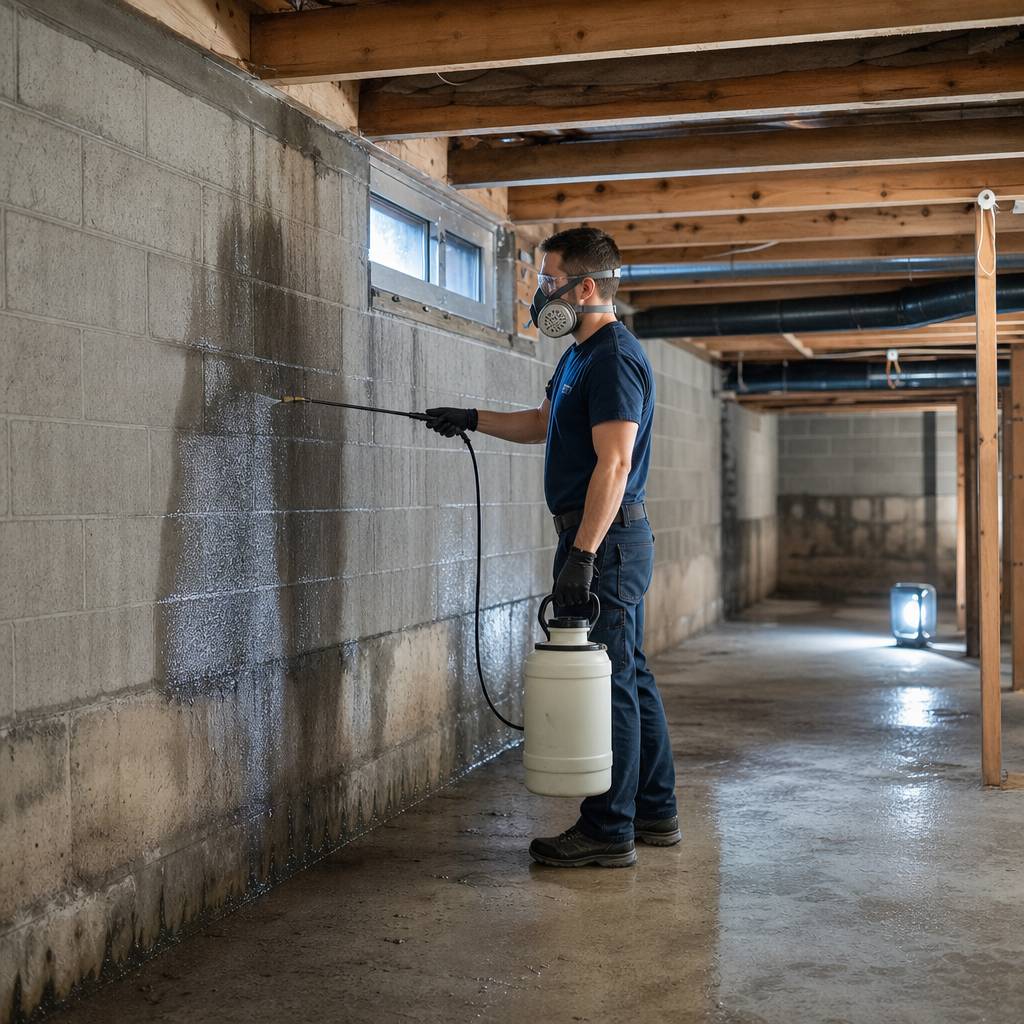
Porous finishing materials that have absorbed contaminated floodwater must be cut out and removed to facilitate drying of the underlying framing.
Executing Controlled Flood Cuts
To access damp framing and allow air circulation behind walls, technicians like those at Floodline Restoration Co. perform straight flood cuts:
- Moisture mapping: Technicians measure moisture migration up drywall and framing studs.
- Precision cutting: Drywall is cut above the water damage line to expose wall cavities.
- Insulation disposal: Saturated insulation is removed and discarded because it cannot be effectively restored once wet.
Evaluating Flooring and Contents
Porous flooring materials and contaminated contents that cannot be salvaged are separated and cataloged for insurance documentation, while salvageable hard surfaces are prepared for cleaning.
Step 4: Decontaminate Masonry, Joists, and Structural Framing
Porous masonry, concrete slabs, and wood framing absorb water and contaminants during a flood event, requiring thorough cleaning and treatment.
Sanitization and Cleaning
Surfaces are cleaned and treated to eliminate contaminants, residues, and odors. Structural framing, sill plates, and concrete surfaces are washed down to ensure safe, sanitary drying conditions.
Step 5: Industrial Structural Drying and Moisture Monitoring
Need basement flood cleanup?
We’re available now - call for a fast, free estimate.
Structural drying removes residual moisture trapped inside framing, concrete, and subfloors to return building components to safe equilibrium moisture levels.
Airflow and Dehumidification
Restoration teams deploy commercial air movers to accelerate surface evaporation alongside dehumidifiers that extract moisture vapor from the air.
Drying Logs
Technicians from Floodline Restoration Co. monitor relative humidity, temperature, and moisture levels in structural materials daily to track drying progress until target moisture standards are reached.
What Does Basement Flood Cleanup Cost?
Consumer cost data in 2026 places average flooded-basement cleanup around $4,000 with common ranges of roughly $2,000 to $7,000.
Total restoration costs depend on the water source, flooded square footage, water depth, exposure duration, and the extent of material removal and reconstruction required.
How to Choose a Certified Flood Restoration Company
When selecting a contractor for basement flood cleanup, verify their industry credentials, emergency availability, and documentation protocols for insurance claims.
Frequently Asked Questions About Basement Flood Cleanup
What should I do immediately after my basement floods?
First, verify electrical safety. Do not enter standing water if electrical panels, outlets, or appliances are submerged. Shut off the water source if the flood is from an interior pipe, call a certified restoration professional, and document damaged property for insurance purposes.
How much does professional basement flood cleanup cost?
Consumer cost data in 2026 places average flooded-basement cleanup around $4,000 with common ranges of roughly $2,000 to $7,000.
Does homeowners insurance cover basement flooding and cleanup?
Standard homeowners insurance policies typically cover sudden, accidental internal water damage like burst pipes, but standard policies generally exclude surface floodwaters, sewer backups, or sump pump failures unless specific endorsements or separate flood policies are in place.
Is it safe to go into a flooded basement with electrical equipment?
No. Never enter standing water with electrical equipment or power tools. Power must be verified as disconnected before entering the flooded area.
How should water be pumped out of a flooded basement?
According to FEMA guidance, water should be lowered slowly, about 1 foot at a time with a 24-hour wait between reductions, to prevent exterior soil pressure from damaging or collapsing foundation walls.
How do professionals extract water and dry out a flooded basement?
Restoration teams like Floodline Restoration Co. extract standing water, remove non-salvageable wet materials, sanitize affected structural elements, and run commercial dehumidifiers and air movers while tracking moisture readings until structural materials are dry.
Need basement flood cleanup?
We’re available now - call for a fast, free estimate.
Sources
- rainfall intensity duration: Topics by … – science.gov (2012)
- Hazus 6.1 Flood Model Technical Manual – fema.gov
- FLOOD RISK AND BASEMENT HOUSING IN NEW YORK … – newyorkfed.org (2024)
- Flood-Prone Basement Housing in New York City and the … – libertystreeteconomics.newyorkfed.org (2021)
- New insights into US flood vulnerability revealed from flood insurance big data – nature.com (2014)
Related reading: Homeowners Insurance Flood Coverage | Call Now-10% Off | Same-Day Service | Free Estimate
Related reading: Mold Remediation Cost | Call Now-10% Off | Same-Day Service | Free Estimate
Related reading: Emergency Water Removal Near Me | 10% Off & Free Estimate | On-Site in 60 Minutes
Frequently Asked Questions
How long does it typically take to completely dry out a flooded basement?
While bulk water extraction takes only a few hours, complete structural drying typically takes between 3 to 5 days depending on the saturation of masonry and framing. Floodline Restoration Co. utilizes commercial LGR dehumidifiers, high-velocity air movers, and daily moisture logs to verify materials reach safe equilibrium levels.
How does Floodline Restoration Co. assist with basement flood insurance claims?
Floodline Restoration Co. provides full insurance claim coordination by compiling itemized damage reports, water line photographs, and detailed thermal moisture mapping data. Our technicians coordinate directly with your insurance adjuster to ensure all required extraction, sanitization, and structural drying services are properly documented.
Why is precision moisture mapping necessary after extracting basement water?
Water rapidly wicks behind drywall and deep into porous concrete slabs, creating hidden moisture pockets that can breed mold within 24 to 48 hours. Floodline Restoration Co. uses advanced moisture meters and infrared cameras to locate concealed dampness and determine the exact height required for clean flood cuts.
About the author
 |
David Harrison David is a certified property restoration specialist with over 12 years of experience in emergency mitigation and structural drying. He holds a degree in Construction Management from the New York Institute of Technology and is an IICRC-certified Master Water Restorer. David specializes in translating complex restoration protocols into actionable advice for property owners navigating unexpected disasters. |
Water damage, flood, or mold emergency?
We’re available now - call for a fast, free estimate.
Call Now - Free Estimate