
Quick Summary
While the typical mold remediation cost ranges from $1,223 to $3,757 with a national average of $2,364, overall expenses vary widely depending on structural containment, moisture source extraction, and porous material demolition. To eliminate surprise contractor charges and support insurance claims, Floodline Restoration Co. delivers transparent, line-item estimates and comprehensive moisture mapping before starting work. Readers will understand key pricing factors across different property types and insurance policies, allowing them to schedule an upfront visual inspection with Floodline Restoration Co. for an accurate, itemized scope.
Mold Remediation Cost: Upfront Pricing for Fast Relief
Most residential mold remediation projects cost between $1,223 and $3,757, with a national average of around $2,364, though costs vary widely by project scale. When dealing with fungal growth in an apartment, brownstone, or commercial facility, the real challenge is rarely just the visible stain on the wall. The true work lies in tracking trapped moisture, setting up proper containment, and clearing the air safely without cross-contaminating the rest of the building.[1]
Many property owners run into vague contractor estimates that start low but balloon with surprise line items for waste disposal, plastic barriers, or equipment runtimes. Floodline Restoration Co. takes a different approach. We pinpoint the moisture source, establish physical containment, and provide itemized, upfront pricing before any demolition begins. Contact us to schedule an inspection and get a clear scope of work for your property.
What Does Professional Mold Remediation Cost on Average?
Average mold remediation costs at a glance: Professional mold remediation costs an average of around $2,364, with a typical homeowner range of $1,223 to $3,757, though costs vary widely depending on project scale.
The typical mold remediation project averages around $2,364, with most homeowner costs falling between $1,223 and $3,757. Costs vary widely by project scale, depending on containment requirements, structural drying demands, and whether contaminated materials must be removed and replaced.
Key Takeaways at a Glance
- Act within 24 to 48 hours: Wet areas should be dried within 24 to 48 hours to help prevent mold growth.
- The 10-square-foot rule: DIY cleanup is generally limited to mold areas about 10 square feet or smaller. Larger contaminated areas require professional remediation.
- Scale drives price: Mold remediation costs vary widely depending on project scale.
- Upfront scoping protects budgets: Securing a written, itemized estimate before work starts prevents surprise charges for air scrubbers, HEPA vacuuming, and disposal.
Typical Mold Remediation Cost Ranges
| Project Scope | Cost Overview | Standard Protocol |
|---|---|---|
| Minor Surface Remediation (about 10 sq. ft. or smaller) | Typical homeowner range of $1,223 – $3,757 (national average around $2,364); costs vary by project scale | Cleaning, HEPA vacuuming, and localized moisture correction. |
| Moderate Contamination | Typical homeowner range of $1,223 – $3,757 (national average around $2,364); costs vary by project scale | Containment, drywall removal, structural drying, and sanitization. |
| Extensive or Structural | Costs vary widely depending on project scale | Containment, structural remediation, and deep drying. |
What Does Mold Remediation Cost? Full Pricing Breakdown
Need mold remediation cost?
We’re available now - call for a fast, free estimate.
To understand what goes into a mold remediation estimate, it helps to distinguish between inspection, active remediation, and post-cleanup restoration. Each phase addresses a specific part of the recovery process.
Itemized Mitigation Rates
| Service Category | Cost Overview | What the Work Covers | Insurance Consideration |
|---|---|---|---|
| Mold Inspection & Moisture Mapping | Varies by scale; overall projects average around $2,364 ($1,223 – $3,757 range) | Thermal imaging, moisture meter mapping, visual assessment. | Often credited toward remediation work. |
| Air Quality & Mold Testing | Varies by scale; overall projects average around $2,364 ($1,223 – $3,757 range) | Spore trap sampling, lab analysis, clearance testing. | Useful documentation for disputed claims. |
| Basement Water Removal & Extraction | Costs vary widely depending on project scale | Standing water extraction, dehumidifiers, air movers. | Covered if caused by sudden internal plumbing breaks. |
| Burst Pipe Cleanup & Containment | Costs vary widely depending on project scale | Air filtration, controlled demolition, drying, and structural cleaning. | Standard covered peril on most property policies. |
| Black Mold Removal Cost (Stachybotrys) | Costs vary widely depending on project scale | Appropriate PPE, containment, and structural cleaning. | Depends on the original water source. |
Why Transparent Line-Item Pricing Matters
In dense metropolitan settings like Long Island City and the surrounding boroughs, standard per-square-foot pricing frequently fails. A small bathroom mold outbreak in a multi-family building can require more containment setup than an entire open garage in the suburbs. Transparent line-item pricing ensures you pay for the actual equipment hours, HEPA filtration units, and labor required for your specific property layout rather than inflated flat-rate assumptions.
Why Square-Footage Estimates Fail in Urban and Historic Properties
Square-footage pricing models break down in urban and historic buildings because they overlook the physical reality of how air and moisture move through connected structures. According to specialists at Floodline Restoration Co., establishing containment, isolating shared ductwork, and drawing water out of dense, historic building materials represent the actual cost drivers.
The Physics of Containment and Air Isolation
In historic industrial lofts, brownstones, and modern high-rises, spaces share plumbing chases, risers, and common ventilation shafts. When mold remediation begins, technicians cannot simply run a fan; doing so would blow fungal spores into neighboring units or shared hallways.
Technicians at Floodline Restoration Co. establish containment barriers and air filtration to prevent spores from spreading. The labor needed to establish containment remains a significant factor whether the mold covers a small area or a larger space.
Historic Substrates vs. Modern Building Materials
Modern suburban homes are built primarily with timber studs and paper-faced drywall. Historic New York buildings feature heavy masonry, thick plaster, terracotta partition blocks, and century-old timber. These materials are deeply porous and act like sponges during water leaks. Extracting moisture from double-wythe brick or heart-pine subfloors demands longer dehumidification cycles and specialized drying equipment, which increases equipment runtime compared to standard drywall repairs.
Drywall, Ceilings, and Insulation: Repair vs. Replace Costs
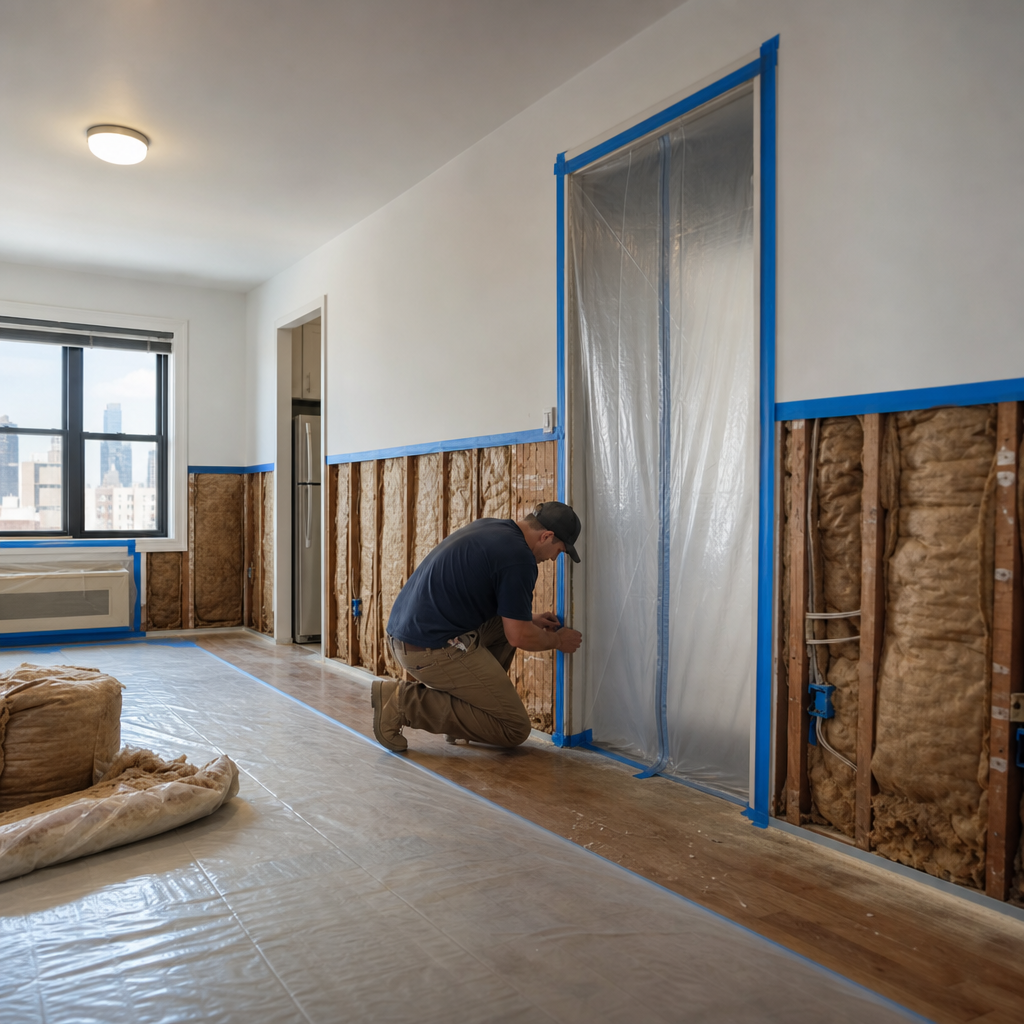
When remediating living spaces, materials fall into two main categories: porous and non-porous. This distinction dictates whether an item can be sanitized in place or must be discarded and replaced.
Identifying Porous Contamination
Porous materials like drywall, ceiling tiles, and fiberglass insulation allow mold roots (hyphae) to grow deep inside their internal structure. Surface wiping might remove the visible discoloration, but the root structure stays alive within the core. Once dampness sets in, soft drywall and damp insulation must be removed under containment, with overall costs varying widely depending on project scale.
Controlled Demolition vs. Surface Sanitization
| Material Type | Standard Protocol | Action Required |
|---|---|---|
| Porous (Drywall, Ceiling Tiles, Insulation) | Controlled Demolition | Remove under containment and replace. |
| Semi-Porous (Wood Framing, Concrete Subfloors) | Surface Remediation | HEPA vacuuming and antimicrobial treatment. |
| Non-Porous (Metal Studs, Glass, Tile Surfaces) | Direct Sanitization | Detergent cleaning and antimicrobial wash. |
Basement, Crawl Space, and Attic Mold Remediation Costs
Need mold remediation cost?
We’re available now - call for a fast, free estimate.
Subterranean and unconditioned areas present specific remediation challenges due to high humidity, soil moisture, and restricted access, with costs varying widely based on project scale.
Basement Mold Removal
Basements frequently suffer from groundwater seepage, poor exterior drainage, and condensation along foundation walls. Remediation here involves removing contaminated organic materials, cleaning exposed joists, and running commercial dehumidifiers. If efflorescence (powdery white salt deposits) is present on the foundation, masonry waterproofing and drainage improvements may be required alongside mold cleanup to prevent immediate regrowth.
Crawl Space Mold Remediation
Crawl spaces combine tight physical access with continuous moisture rising from the earth. Complete remediation often includes removing organic debris, treating floor joists with antimicrobial coatings, and installing a heavy-duty vapor barrier across the dirt floor to isolate the house from ground dampness.
Attic Mold Remediation
Attic mold is typically driven by inadequate roof ventilation, disconnected bathroom exhaust fans blowing moist air into the attic, or subtle roof leaks. Technicians must treat the underside of the roof sheathing and roof trusses, followed by correcting the ventilation imbalance.
Does Homeowners Insurance Cover Mold Remediation Costs?
Whether property insurance pays for mold remediation depends almost entirely on the underlying cause of the moisture.
Covered Perils vs. Maintenance Exclusions
- When insurance typically covers mold: Policies generally cover remediation when the mold directly results from a sudden, accidental water loss that is itself covered. Examples include a sudden burst supply line, a ruptured water heater tank, or water damage from firefighting efforts. In these situations, filing a water damage insurance claim can cover both the water extraction and resulting mold cleanup.
- When insurance typically denies coverage: Standard property policies exclude mold caused by ongoing maintenance oversights, long-term pipe trickles, high indoor humidity, roof leaks that went unaddressed for months, or exterior ground flooding (unless you carry a separate flood policy).
To support a claim, ensure your contractor, such as Floodline Restoration Co., provides detailed moisture logs, date-stamped thermal images, and an itemized line-by-line estimate that clearly links the microbial growth to the sudden water event.
Frequently Asked Questions About Mold Remediation
How much does professional mold remediation cost on average?
Nationally, mold remediation averages around $2,364, with typical homeowner costs ranging between $1,223 and $3,757, though costs vary widely depending on project scale.
What is the difference in cost between mold inspection, testing, and remediation?
A mold inspection involves a physical walkthrough and moisture mapping to find where water is hiding. Mold testing collects air or surface samples for laboratory analysis to determine spore counts and species. Mold remediation is the physical process of containing, removing, and cleaning mold-affected structures, with overall costs typically averaging around $2,364 and ranging from $1,223 to $3,757, though costs vary widely depending on project scale.
Is mold remediation worth the cost or can I do it myself?
DIY cleanup is generally limited to mold areas about 10 square feet or smaller. If the mold covers an area larger than 10 square feet, stems from contaminated water, or extends behind drywall, professional remediation from Floodline Restoration Co. is recommended.
What factors increase the cost of mold remediation?
Key cost drivers include the physical accessibility of the space (such as tight crawl spaces or high ceilings), whether HVAC ductwork has been contaminated, the volume of structural drywall and subflooring that must be replaced, and the duration of commercial dehumidification required to hit dry standards.
How quickly does mold develop after water damage?
Wet areas should be dried within 24 to 48 hours to help prevent mold growth. Immediate water extraction and prompt drying are essential to prevent moisture from causing further damage.
Need mold remediation cost?
We’re available now - call for a fast, free estimate.
Sources
Related reading: Emergency Water Removal Near Me | 10% Off & Free Estimate | On-Site in 60 Minutes
Related reading: Emergency Water Extraction – 10% Off & Free Estimate – On-Site in 60 Minutes
Frequently Asked Questions
How does direct insurance billing work for mold remediation costs?
When mold stems from a covered peril such as a sudden pipe burst, Floodline Restoration Co. bills your insurance carrier directly to reduce out-of-pocket expenses. Our team provides date-stamped thermal imaging, moisture logs, and itemized line-by-line estimates to substantiate the claim with your adjuster.
How long does professional mold remediation take, and can I stay in the building?
Most residential projects take between one and five days depending on the required drying cycles and structural demolition. Floodline Restoration Co. uses sealed negative air containment zones to prevent cross-contamination, often allowing occupants to safely remain in unaffected areas of the property.
What is included in an upfront visual mold inspection from Floodline Restoration Co.?
Our technicians perform a thorough walkthrough using moisture meters and infrared thermal imaging to locate hidden water pockets behind walls and flooring. Following the assessment, you receive a transparent, itemized estimate outlining exact labor, filtration, and containment costs before any physical remediation begins.
About the author
 |
Sarah Miller Sarah Miller is a certified water damage restoration specialist with over eight years of experience working closely with property owners in the New York metropolitan area. She holds a B.S. in Construction Management from Pratt Institute and specializes in transparent cost estimation and structural mitigation protocols. Sarah is passionate about helping clients navigate complex insurance claims and restoring their properties efficiently. |
Water damage, flood, or mold emergency?
We’re available now - call for a fast, free estimate.
Call Now - Free Estimate