
How to Choose the Right Damage Restoration Company in Long Island City
The right damage restoration company in Long Island City is the one that handles the full job itself, from first extraction through final rebuild, and gives you a written guarantee before you sign anything. Most homeowners ask about certifications and response time. The question that actually predicts your outcome is narrower: who signs the completion certificate, and is it the same company that ran the extraction?
If you’d rather skip the research and talk to someone now, call (716) 452-0798 for a free estimate.
At Floodline Restoration Co., we’ve been doing this since 2010, and we’ve watched too many Long Island City homeowners get handed off between a mitigation crew and a reconstruction contractor who never met each other. The paperwork gaps that follow are predictable. So are the delays. Here’s how to avoid that, step by step.
Key Takeaways
- The single most important question is whether one company owns the job from start to finish.
- Direct insurance billing requires licensing, carrier relationships, and Xactimate proficiency. Most contractors claiming it are just filing paperwork the adjuster will push back on.
- A real moisture log contains calibrated readings. A completion form without data is a sign-off, not proof.
- Co-op and condo boards in Long Island City often maintain approved vendor lists. Choosing an unlisted company can stall a job mid-project.
The Wrong Question: Why Certifications Don’t Predict Your Outcome
Every restoration company in Long Island City claims IICRC certification, fast response, and insurance experience. These claims are table stakes now, not differentiators. When every bid says the same thing, none of it helps you choose.
The question homeowners ask, “Are you IICRC certified?”, is the right category but the wrong question. Certification tells you a technician passed a course. It does not tell you whether the company that dries your floor joists is the same one that will rebuild your kitchen wall. It does not tell you who pays for a failed repair three months later. It does not tell you whether your insurance claim stalls because the mitigation crew’s logs don’t match the rebuild crew’s scope.
In our experience in Long Island City, the companies with the most credentials on their website are sometimes the ones with the most handoffs in their workflow. The training matters. It just isn’t the filter that predicts your result.
The Filter That Actually Works: Full-Cycle vs. Split-Model
Here’s the distinction nobody explains clearly enough. A full-cycle restoration company handles extraction, drying, mold work, and rebuild with its own certified crew. A split-model company does the emergency mitigation, then hands the reconstruction to a separate contractor, often a sub they rarely work with.
Why does that matter? Because the handoff is where documentation breaks down. The mitigation crew leaves a moisture log and a scope of work. The reconstruction contractor writes a new estimate. When the insurance adjuster asks why those two documents don’t line up, there’s no single person who can answer. Supplements get orphaned. The homeowner ends up carrying paperwork between two companies that don’t answer to each other.
And workmanship accountability vanishes. Ask a split-model mitigation company who guarantees the rebuild their sub performed. The answer is usually silence or finger-pointing. A full-cycle company signs the completion certificate. That signature means something when the same name was on the extraction.
Floodline Restoration Co. started with a simple structure: one dispatch board, one crew, one guarantee. Curt Bowman, our owner, set it up that way in 2010. When you call us about water damage restoration in Long Island City, the same team that reads the moisture map on day one handles the daily readings, hands the log to you and your carrier, and rebuilds what needs rebuilding. No handoff. No inherited crew.
Five Questions to Ask Before Signing Anything
The authorization form is where the split-model problem gets locked in. You can avoid it by asking the right questions before you sign. Here are five, with honest answers to listen for.
- “Who signs the completion certificate, and are they the same company running the extraction?” A trustworthy answer names the company and confirms the same crew handles both. A deflection changes the subject to response time or discounts.
- “If the rebuild fails six months from now, do I call you or someone else?” Listen for a direct answer: “You call us.” If the answer involves a subcontractor’s warranty or a separate phone number, walk away.
- “Do you bill my insurance carrier directly, or do I pay upfront and file myself?” This one separates the real operation from the paperwork shufflers. See the section below for what direct billing actually requires.
- “Can I see a moisture log from a recent job with the actual readings?” Any company running professional-grade equipment can show you this in minutes. A blank look means they’re not logging.
- “Are you on my building’s approved vendor list?” In Long Island City, this question saves you from mid-project halts. If the company doesn’t know what an approved vendor list is, they haven’t worked in LIC co-ops or condos.
What Direct Insurance Billing Actually Requires
Most local contractors in Long Island City say they “work with insurance.” That sentence can mean anything. What direct insurance billing actually requires is three specific things: proper licensing that satisfies carrier requirements, established relationships with the major carriers’ adjuster networks, and fluency in Xactimate, the industry-standard estimating software.
Without Xactimate proficiency, a contractor submits an estimate formatted like a remodel bid. The adjuster opens it, sees line items that don’t match carrier pricing standards, and kicks it back. The homeowner waits. The contractor resubmits. The homeowner waits again. It’s not insurance handling. It’s insurance paperwork theater.
When we handle fire and smoke damage restoration in Long Island City, we bill the carrier directly using Xactimate line items that adjusters recognize. We’ve built those relationships over 42 years in local communities. What that means for you: no surprises on the bill, and you never play messenger between Floodline and your carrier.
Ask any contractor you’re considering whether they write their own Xactimate estimates in-house. If they outsource estimate writing to a third-party billing service, that’s another handoff in your project. Another gap where details get lost.
The Moisture Log: The Best Quality Check You’ve Never Used
At job close, most homeowners get a sign-off form that says the property is dry. That form is nearly worthless unless it’s backed by data.
A real moisture log contains daily readings from calibrated meters, recorded by the same technician who set the drying protocol on day one. The readings show the progression: day one baseline, day three target reductions, day seven confirmation that materials reached the dry standard. They’re not just numbers. They’re the only objective proof that the drying worked.
A generic completion form, by contrast, has a signature and a checkbox. It tells you the company says it’s dry. It tells you nothing about whether the floor joists behind that baseboard actually reached the moisture content that prevents mold growth.
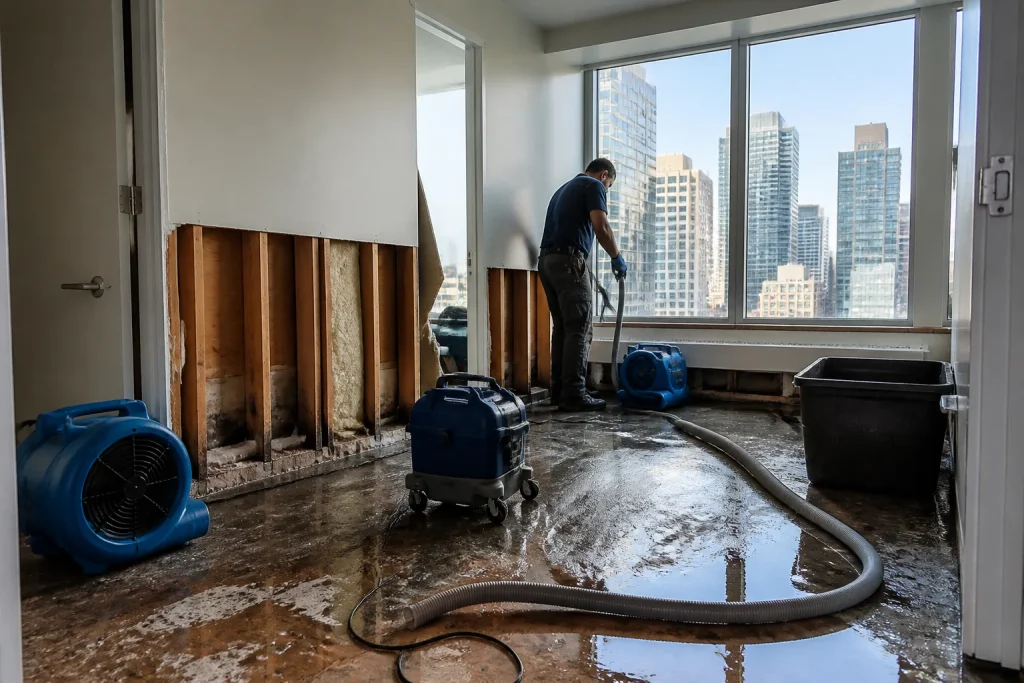
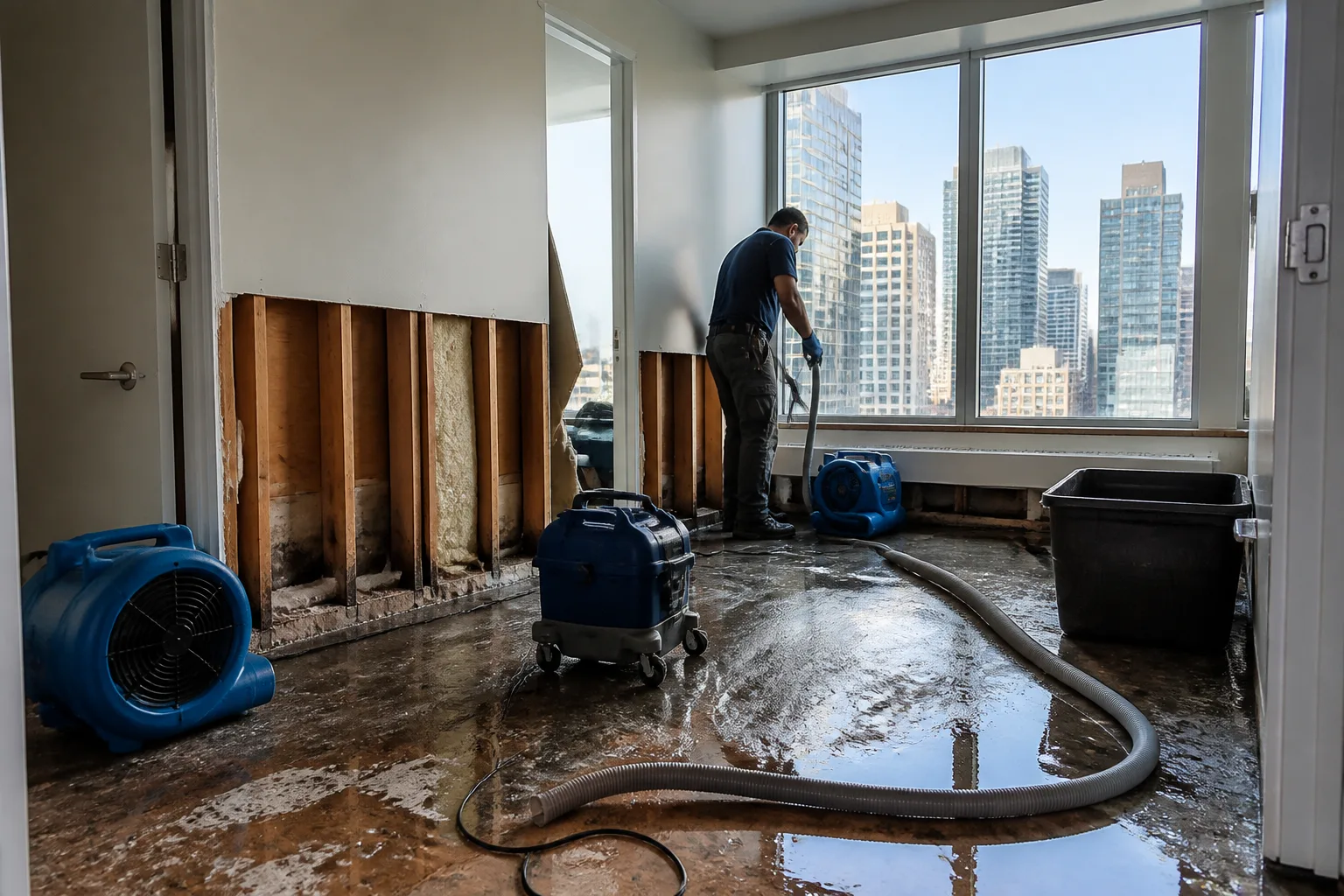
Request the actual data readings at job close. Not a summary. The readings. Any company running Dri-Eaz, Phoenix, or XPOWER equipment with a competent technician can produce them. If they can’t, they weren’t taking them.
This matters especially in Long Island City basements, where the water table and older building envelopes make thorough drying harder. We pulled a dehumidifier out of a co-op on Vernon Boulevard a few years back where the previous company had signed off on a “dry” basement that was still reading 22% moisture content in the sill plate. The homeowner had started smelling mildew and couldn’t figure out why. The receipt said dry. The wood said otherwise.
The LIC Complication Nobody Mentions: Co-op and Condo Boards
Long Island City has one complication that most restoration guides ignore entirely. A huge share of the housing stock here is co-ops and condos, and many boards maintain approved vendor lists. If the company you hire isn’t on the list, the board can stop the job mid-project. Not because of workmanship, but because of liability requirements and insurance paperwork the board needs on file.
This creates a specific risk for split-model work. The mitigation company might be approved. The reconstruction sub they hire may not be. The board halts the rebuild. The homeowner now has a gutted kitchen and a board dispute.
Before you authorize any work in a co-op or condo building in Long Island City, call the management office and ask about vendor requirements. Then confirm that the restoration company has those documents ready. If you need mold remediation in Long Island City and your board requires specific certifications or insurance minimums, get that in writing before the first technician walks in.
We keep current certificates and insurance documents ready for building management exactly because this is such a common stall point here. It’s a five-minute conversation that saves weeks of delay.
When to Call a Pro
If you’re reading this at two in the morning with water spreading across your floor, this is not the time to compare five companies. Call a live dispatch line. If a recording answers, call someone else. A real restoration company picks up the phone with a person at any hour, every day of the week.
Catastrophic water, sewage backup, or fire damage are not DIY situations. A high-tension garage door spring snapping is dangerous. A flooded basement with live electrical outlets is dangerous. Sewage carries pathogens. Fire smoke leaves residues that require professional chemistry to neutralize properly. If the job involves electrical panels, gas lines, or structural framing, the right move is a certified crew, not a YouTube tutorial. Serious injury from improper handling is a real risk.
Related services in Long Island City: Water Damage Restoration, Mold Remediation, Fire & Smoke Restoration. All handled full-cycle by the same crew, with a moisture log and a written guarantee at the end.
The Bottom Line
Choosing a damage restoration company in Long Island City comes down to one structural question: does this company own the whole job? If the answer is yes, and they put that in writing, and they can show you moisture data from past jobs, you’re probably dealing with a real operation. If the answer is a hazy explanation about “our trusted partners,” you’re buying a handoff, not a solution.
Floodline Restoration Co. has been serving Long Island City since 2010. We answer the phone with a live person at 2 a.m., we run professional-grade Dri-Eaz and Phoenix equipment with daily logged readings, and we back every job with the 90-Day Done Right Promise in writing. No paperwork battles. Just a square deal. If you’re in Long Island City and need help, we offer free estimates. Call (716) 452-0798.
Frequently Asked Questions
A company with live 24/7 dispatch should have a crew at your door the same day for water, sewage, or fire mitigation. Ask when you call whether a technician is being dispatched immediately. If the phone goes to voicemail at 2 a.m., that’s your answer about response time. Call (716) 452-0798 to reach a live dispatcher now.
Most homeowner policies cover sudden water, fire, and storm damage, subject to your deductible and policy limits. The question that matters more is whether your restoration company can bill the carrier directly with an Xactimate estimate the adjuster accepts. Ask that question before signing. Floodline Restoration Co. handles direct insurance billing so you don’t carry paperwork between two companies.
If water has been sitting for more than 24 hours, or it’s sewage-affected, or it’s soaked into drywall or flooring, DIY drying usually leaves moisture trapped where you can’t see it. That’s how mold starts. A professional crew with moisture meters can tell you what’s actually wet. The assessment costs less than a secondary mold remediation.
Many Long Island City co-ops and condos maintain approved vendor lists and require specific insurance certificates before work starts. Call your management office first, then confirm the restoration company has those documents ready. A company that works regularly in LIC buildings will know exactly what’s needed.
Written by Curt Bowman, Owner at Floodline Restoration Co., serving Long Island City since 2010.
Need Damage Restoration Help?
Call Floodline Restoration Co. - licensed & insured, available 24/7 in Long Island City.
(716) 452-0798