
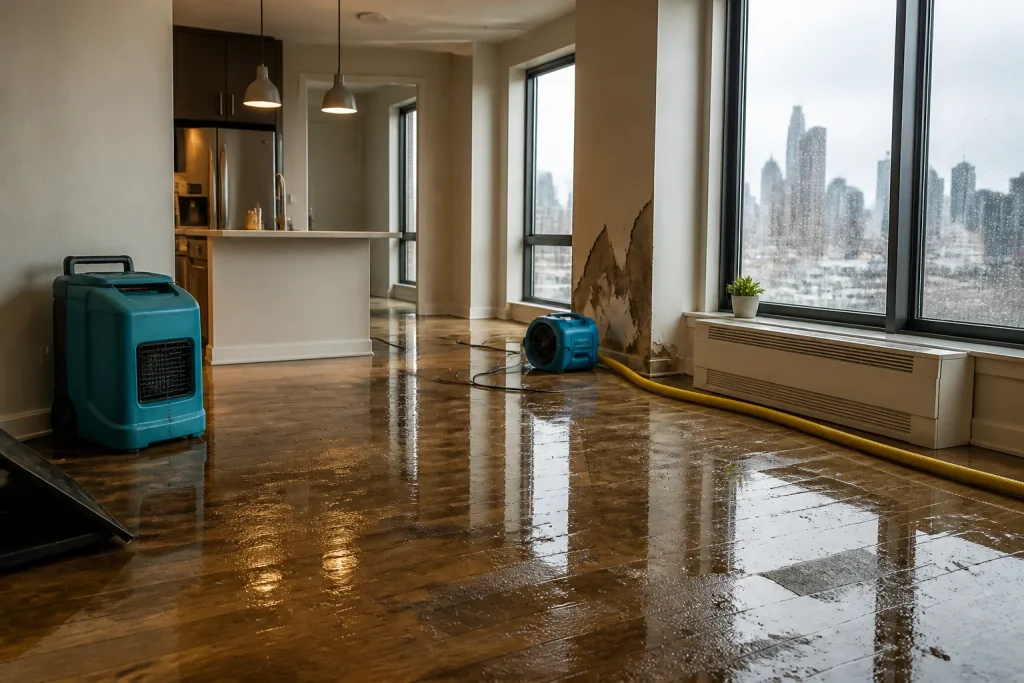
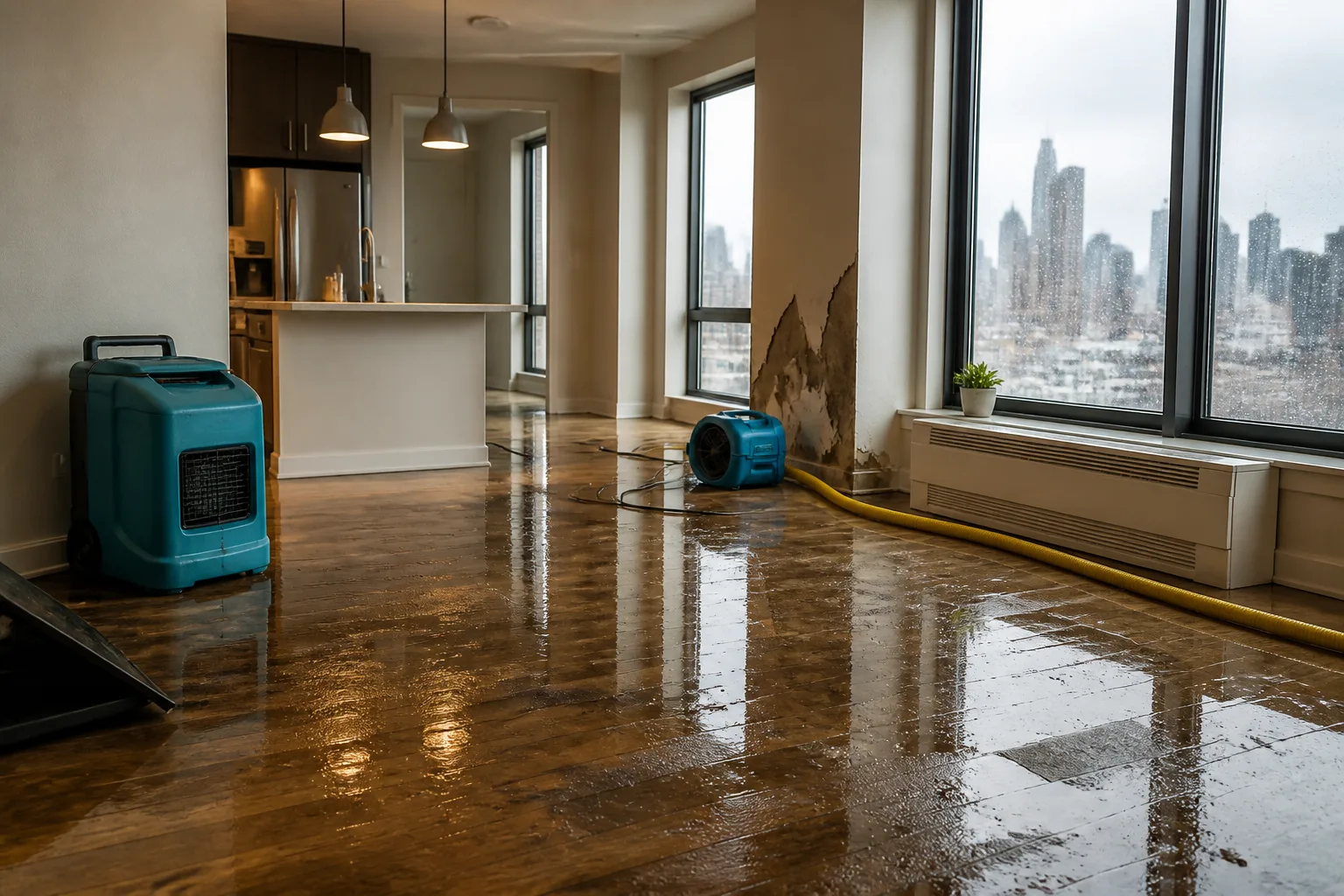
Emergency Water Damage Restoration Near Me: What Long Island City Homeowners Should Do First
The first 90 minutes after water intrudes into your Long Island City home are the only window where your actions meaningfully change the final restoration bill. Most of what circulates online about “what to do first” is either too vague to act on or actively wrong for the building types common here. If you’d rather not sort through advice while standing in an inch of water, call (716) 452-0798 and a live dispatcher will walk you through the next steps. If you want to know exactly what to do and in what order, read on.
Why the First 90 Minutes Decide Your Restoration Bill
Grabbing towels is the instinct. It’s also mostly wasted effort. The decisions that determine whether you pay $2,000 or $12,000 happen in the calls you make and don’t make in the first hour, not the mopping. Water doesn’t stop moving when you stop looking at it. It wicks up drywall, travels along floor joists, seeps under baseboards, and finds its way into wall cavities where the real damage begins. In Long Island City, where a large share of housing stock is attached construction, co-ops, condos, and converted industrial buildings, water from your unit rarely stays in your unit. It moves into shared walls, down into the unit below, and through common-area floors. That shared damage can turn a straightforward insurance claim into a liability dispute with a neighbor or a building management conflict. The clock starts the moment the leak stops, not when you notice it. Every hour of standing water, even in a contained area, extends the drying timeline and increases what gets cut out and replaced. What you do in the first hour and a half determines whether we’re extracting, drying, and patching or gutting to the studs and rebuilding. That’s not a scare tactic. That’s a materials reality: drywall wicks water to roughly 30 inches in under an hour, and saturated drywall loses structural integrity even before mold appears.
A 90-Minute Sequence Specific to Long Island City
Here is the exact order of operations we recommend for LIC homeowners, accounting for the building types here. This is not the generic list you’ll find elsewhere.
- Minutes 0-10: Stop the source if you safely can. For a unit-level leak like a failed supply line under a sink or a washing machine hose, you’re looking for the shutoff valve at the fixture itself. In a condo or co-op, that’s typically yours. But if the water is coming from a riser pipe, a heating line, or the unit above you, the building’s shutoff is the one that matters, and you can’t and shouldn’t touch the riser valve. A riser shutoff affects every unit stacked above and below; in many co-op governing documents, touching it without building permission violates your proprietary lease. Call your super or building management first for any riser-related water. For unit-level water, close the nearest fixture valve and then call the building anyway, because water that’s already traveled may affect the unit below.
- Minutes 10-30: Notify building management, in writing. Most co-op and condo proprietary leases have a notification clause, and your failure to notify can become your liability. Send an email or text, not just a phone call. Note the time you first saw water, the source if you know it, and which rooms are affected. If water has entered a shared wall, say so explicitly. That sentence protects you when a neighbor’s unit shows staining two weeks later and the building tries to assign the damage to your delayed report.
- Minutes 30-60: Document before anything gets moved. Take photos from the doorway of every affected room. Get close-ups of baseboards, the waterline on walls, and any shared-wall penetration points like outlets, baseboard registers, and pipe chases. Photograph the water in place before you lift a single wet towel. Why before moving anything? Because an adjuster who arrives later can’t reconstruct the original waterline if you’ve already mopped and moved furniture, and a neighbor’s claim against your unit’s coverage gets weaker when the photographic record shows exactly where water pooled. If you’ve got a shared wall, photograph both sides of it in your unit: the floor line on your side and any staining or bubbling on the wall itself.
- Minutes 60-90: Shut off power only if water is near outlets, and call a restoration company. If water is within a few feet of floor outlets, do not walk through it. Shut off the breaker controlling that room only if the panel is dry and accessible, otherwise call the building electrician. Then call a restoration company. A real emergency response will tell you to document first, not demand a credit card before they’ve looked at a photo. Ask them what they’re bringing to the site on the first visit. If the answer isn’t extraction equipment, that’s a red flag we’ll address below.
Why You Don’t Call Your Insurance Carrier First
The standard advice is to “call your insurance company right away.” In practice, doing that before a restoration company has documented the scene can lock in a lower damage figure than you’re actually facing. Here’s the order of operations that matters. An insurance adjuster’s job is to settle claims for the least amount the policy supports. When the carrier is the first call you make, the adjuster arrives to a scene that hasn’t been documented by anyone working for you, takes their own measurements and photos, and the claim file is opened with that preliminary damage figure. Wet drywall that hasn’t been cut away yet looks less damaged in photos than it actually is. Water that’s migrated into a wall cavity is invisible until someone trained in moisture mapping reads it. If you call Floodline Restoration Co. first, our certified technicians arrive, extract standing water, map the moisture with professional-grade equipment, and document the full extent before any repair decisions get made. The moisture log, the photos, and the damaged-material inventory get shared with your carrier. That’s the difference between a claim that reflects the real loss and a claim that reflects what the adjuster could see on a Tuesday afternoon before the wall cavities were opened. Call us at (716) 452-0798, get the documentation started, and then call your carrier. That order protects your claim. We bill the carrier directly, so you’re not left carrying costs while a claim is pending.
The Mold Clock Is Faster in LIC Basements Than Most Sources Admit
You’ve probably read that mold colonization takes 24 to 48 hours. That’s chemically true under standard conditions. Long Island City’s ground-floor and basement units often don’t present standard conditions. A sewer backup in a below-grade unit adds organic material to the water, which feeds mold and bacteria growth substantially faster. A sump failure during a warm, humid stretch, common in Queens from June through September, creates the warm, moist, stagnant-air conditions mold needs to establish in a fraction of the usual time. In these units, we routinely see visible mold beginning under baseboards in under 24 hours, especially on the unexposed backside of drywall. That timeline is why extraction alone isn’t the end of the job. The water you can see is removed, but the moisture that’s soaked into the drywall, the sill plate, and the subfloor has to be dried to a measurable standard, not just until it “feels dry.” We record daily readings with Dri-Eaz and Phoenix equipment and hand you the moisture log when the job is done. That log is the proof your home hit the dry standard, and it’s the document that protects you if mold appears six months later from moisture we should have caught. If you’re in a Long Island City ground-floor unit and you’ve had sewer water sit for even a few hours, don’t wait the recommended 48 hours to see what develops. Call us. The clock is already against you. We also handle Mold Remediation in Long Island City when water damage has already progressed, and the same crew handles both phases.
What a Real 2 A.M. Emergency Response Looks Like
We answer the phone with a live person at 2 a.m. Not a recording. Not a callback service. A dispatcher who can tell you what to do in the next five minutes and get a crew rolling. Here’s what we actually send when a homeowner calls us at two in the morning from a flooded Long Island City apartment. A certified crew arrives in company vehicles, not a single technician in a van with a moisture meter. The first visit includes extraction: a truck-mounted or portable extraction unit pulling standing water from floors, carpets, and hard surfaces. It includes professional-grade drying equipment from Dri-Eaz, Phoenix, XPOWER, and B-Air set up where the moisture map says it belongs, not where it’s easiest to plug in. It includes a documented moisture map of the full affected area, not a verbal “yeah, it’s wet in there.” And it includes photos taken before anything is moved or removed, with a written scope of work you see before we start cutting. If a company sends one person with a meter and tells you they’ll “check back tomorrow,” that’s not an emergency response. That’s a sales visit. A legitimate 2 a.m. response means extraction is running during that first visit. Water is leaving your home before sunrise, and the drying plan is already in motion. That’s the difference between a crew that’s built around a dispatch board, as we’ve been for over 42 years serving local communities, and a call center that happens to subcontract someone who owns a wet-vac. If the person on the other end of the phone can’t tell you what equipment they’re bringing, hang up and call (716) 452-0798.
What Not to Do: The Mistakes That Cost More Than the Water Itself
Half the expensive damage we see in Long Island City isn’t from the original water. It’s from well-intentioned efforts in the first few hours. Here’s the short version of what to avoid. Don’t run personal fans, especially box fans and bathroom exhaust fans, pointing at wet walls. Household fans move air across the surface but don’t pull moisture from inside wall cavities. Worse, they can spread humidity from the wet area into dry rooms, extending the damage footprint. Don’t remove baseboards, trim, or drywall before you document. You might be trying to help, but you’re also removing evidence the adjuster and our team need to establish the full extent. Don’t accept a verbal scope of work over the phone. Any legitimate restoration company in Long Island City will walk the site, read the moisture, and put a written scope in front of you before swinging a hammer. A verbal quote over the phone without an on-site assessment is how homeowners end up with change orders that triple the bill. Don’t wait to “see if it dries on its own.” A wall that feels dry on the surface is not dry in the cavity. Surface-dry walls harbor the moisture that becomes mold and rot. Call a certified technician to read the wall with a moisture meter. One last one, from an actual call we ran over in Hunters Point: we pulled saturated drywall out of a ground-floor unit where the homeowner had spent four days running a dehumidifier and was sure it was “almost dry.” The backside of the drywall was damp enough to grow mold, and the sill plate behind it was soaked. Four days of dehumidifier time cost him a longer rebuild than a same-day extraction would have. The dehumidifier wasn’t the problem. Waiting was.
If you’re reading this while water is currently in your Long Island City home, put the phone down and call (716) 452-0798 right now. We’ll stay on the line and tell you what to do before the crew arrives.
When the water’s out and the drying starts, we also handle the follow-on work so you don’t end up with a mid-job handoff: Water Damage Restoration in Long Island City, Fire & Smoke Damage Restoration in Long Island City, and full reconstruction. And if you’re just researching before trouble hits, you can get to know us at the Floodline Restoration Co. home page.
The Bottom Line
The first hour after water intrusion is a sequence of decisions, not a cleaning project. Shut the right valve, notify building management in writing, document before you touch anything, call a restoration company before you call the carrier, and don’t run fans into wet walls or wait to see if it dries. The mold clock in LIC’s ground-floor and basement units moves faster than the generic 24 to 48 hour guidance, and shared-wall damage in co-ops and condos comes with documentation obligations that determine liability. A legitimate emergency response means extraction running on the first visit, professional-grade equipment, a written scope, and a moisture log you can hold someone accountable to. Done right, and backed in writing. If you’re in Long Island City and need help, Floodline Restoration Co. offers free estimates. Call (716) 452-0798. We’ll be there when we say.
Frequently Asked Questions
If you call (716) 452-0798, a live dispatcher answers at any hour and a certified crew is dispatched immediately, with extraction running during the first visit. We don’t take messages at 2 a.m. and call back in the morning. The crew arrives in company vehicles with extraction and drying equipment, not a single technician with a meter.
Most homeowners and condo policies cover sudden and accidental water damage, but the documentation sequence matters. We photograph and moisture-map the scene before the adjuster arrives, share our written scope and moisture log with your carrier, and bill the carrier directly. Call us first, then your carrier. That order protects the size of your claim.
Household fans don’t pull moisture from inside wall cavities, and they can spread humidity into dry rooms. A wall that feels dry on the surface may still be wet behind the drywall. We’ve pulled saturated material out of Long Island City units where homeowners ran dehumidifiers for days. The professional answer requires moisture readings, not a hand on the wall. Call (716) 452-0798 for an honest assessment, and estimates are free.
Every Floodline Restoration Co. job is backed by a written guarantee, known internally as the Keystone Standard. If the work isn’t done right within 90 days, we make it right. No paperwork battles, no arguing. It’s tied to our K.E.Y.S. values code: Krafted right, Every time, Your home first, Standing behind it. The guarantee is in writing before we start.
Written by Curt Bowman, Owner at Floodline Restoration Co., serving Long Island City since 2010.
Need Damage Restoration Help?
Call Floodline Restoration Co. - licensed & insured, available 24/7 in Long Island City.
(716) 452-0798