
Quick Summary
Following a property blaze, immediate fire damage repair LIC solutions are vital to extract suppression water, halt corrosive soot damage, and stabilize Queens buildings ranging from historic industrial lofts to modern high-rises. Floodline Restoration Co. serves as Long Island City's premier emergency responder, executing targeted hazard mitigation, soot neutralization, and specialized masonry restoration to prevent long-term structural loss. Readers will understand how to navigate restoration costs and insurance claims, enabling them to call Floodline Restoration Co. for 24/7 emergency dispatch or book a free visual inspection and written scope of work.
Emergency Fire Damage Repair in LIC: Mitigation and Recovery Guidance
When a fire strikes a property in Long Island City, the visible flames are only the first wave of destruction. Most long-term structural and financial loss happens in the hours and days that follow, when soot, smoke residues, and firefighting water settle into building materials. Getting restoration crews like Floodline Restoration Co. on-site quickly stabilizes the property, halts corrosive damage, and helps prevent secondary mold growth.[2]
According to the FDNY Mayor’s Management Report, New York City recorded 20,180 structural residential fires and 4,887 structural non-residential fires in Fiscal Year 2025 (both citywide increases over FY 2024). Serious incidents – classified by the FDNY as an All Hands alarm or higher – require at least 60 FDNY personnel and massive volumes of suppression water. While the FDNY report tracks citywide totals rather than separate neighborhood figures for Long Island City, properties may face varied recovery challenges depending on building age, construction type, and local site conditions.[1] See also Water Damage Restoration Cost & Pricing in Long Island City – Call Now-10% Off – Same-Day Service – Free Estimate.
Emergency Fire Damage Repair in LIC: Scope and Response
Emergency fire restoration is an immediate stabilization process designed to secure the building envelope, extract water, and protect salvageable structural assemblies. In the dense urban environment of Long Island City, securing a site requires coordination with first responders, building managers, and municipal inspectors.[4]
Immediate Hazard Mitigation and Board-Up Services
Work should begin only after the property is cleared for entry by the appropriate authorities and is safe to access. The immediate sequence of emergency services includes:
- Envelope Board-Up and Roof Tarping: Fire suppression frequently involves forced entry, broken windows, and ventilation cuts through roofs. Plywood board-ups and heavy-duty weather barriers prevent weather intrusion, theft, and unauthorized entry.
- Standing Water Extraction: Technicians deploy commercial-grade submersible pumps and extractors to pull standing water from subfloors, concrete slabs, and subterranean basements before structural rot or microbial growth begins.
- Corrosion Control and Surface Stabilization: Synthetic materials produce acidic soot when burned. Applying pre-cleaning neutralizing agents, as recommended by Floodline Restoration Co., helps stop this soot from etching glass, tarnishing metal fixtures, and pitting appliances.
Mitigation vs. Full Reconstruction
Property owners should understand the distinction between emergency mitigation and full reconstruction. Emergency mitigation stops active damage (water removal, board-up, structural drying, and soot cleanup) so the property is stable and safe for evaluation. Capital reconstruction involves rebuilding framing, hanging drywall, installing new electrical and mechanical systems, and completing finish work to return the property to pre-loss condition, which requires city building permits, inspections, and formal scopes of work.[5]
What Does Fire Damage Repair in LIC Cost?
Because every fire involves different burn patterns, structural damage levels, and water volumes, there is no single average cost for fire restoration in Long Island City. Accurate restoration pricing requires an in-person structural assessment, moisture mapping, and an itemized line-item scope written in industry-standard estimating software like Xactimate.
Key Factors Influencing Overall Repair Budgets
- Square Footage and Burn Severity: Light smoke damage confined to a single room requires surface cleaning and air scrubbing, whereas heavy structural burns require selective demolition, framing replacement, and debris removal.
- Water Saturation Levels: Multi-story buildings where hose water pooled on upper floors require extensive drying setups, moisture meters, thermal imaging cameras, and commercial desiccant dehumidifiers.
- Building Architecture and Access: Properties in LIC may require specialized scaffolding, negative air pressure containment setups, or careful coordination of freight elevators, shared access points, and occupant protections depending on the structure.
- Hazardous Materials: Pre-war and mid-century Queens properties may contain lead paint or asbestos in pipe insulation, plaster, or floor tiles. If disturbed by fire or suppression efforts, these materials require certified environmental remediation alongside standard fire cleanup.
Treating Porous Brick and Masonry in Restoration
Need fire damage repair LIC?
We’re available now - call for a fast, free estimate.
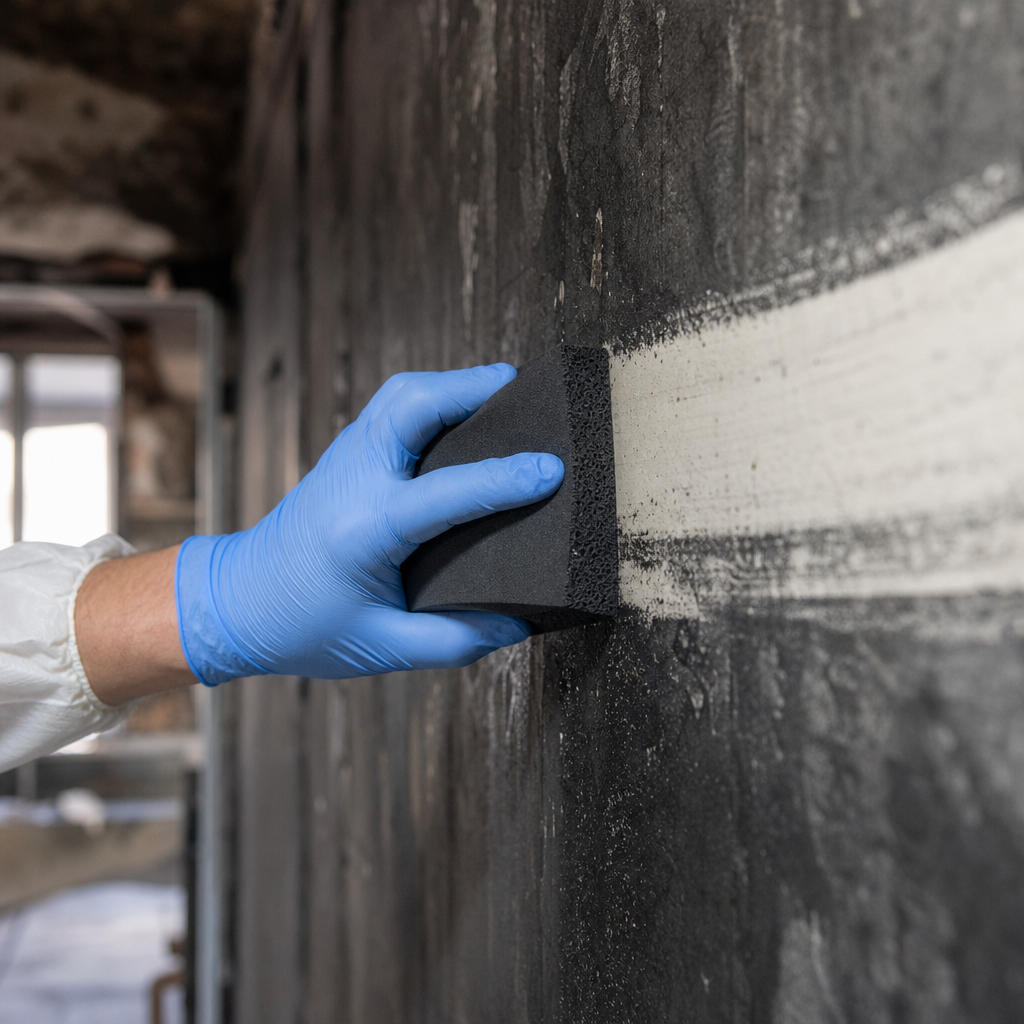
When fires involve modern synthetic materials or lithium-ion batteries (the FDNY recorded 277 lithium-ion battery fires across NYC in 2024), soot residues settle onto masonry surfaces and mortar joints.[3]
According to Floodline Restoration Co., cleaning methods should be selected based on the masonry type, soot characteristics, moisture conditions, and professional assessment. Improper washing techniques or inappropriate chemical cleaners can force residues deeper into porous brickwork or affect mortar. Professional evaluation determines whether dry sponging, non-abrasive media blasting, or other specialized restoration techniques are appropriate for the specific materials and conditions present.
Smoke Migration Through Vertical Utility Risers
In multi-story buildings, smoke may not remain contained within the room of origin. Vertical utility risers, electrical conduits, pipe chases, and elevator shafts can potentially draw soot and smoke upward to upper floors depending on airflow and building layout. Professional assessment is necessary to determine whether isolating vertical chases, running HEPA air scrubbers under negative pressure, or sealing riser entry points is required.
Restoring Building Components: Drywall, HVAC Ducts, and Framing
Evaluating which materials can be saved versus what must be removed is determined through inspection, structural safety assessments, moisture mapping, and applicable building codes.
Drywall, Insulation, and Framing
Drywall and insulation that have sustained direct flame contact, charring, structural compromise, or heavy water saturation may require removal based on moisture assessment and safety evaluations. Structural timber or steel framing that retains load-bearing capacity and meets code requirements can often be cleaned, treated with antimicrobial solutions, and sealed with specialized primers following thorough inspection.
HVAC Ductwork Remediation
If an HVAC system was operational during or after a fire, soot particulates may be drawn into supply and return ducts, potentially affecting coils, blower components, and interior duct linings. A professional assessment by teams like Floodline Restoration Co. will determine the necessary remediation steps, which may include:
- Sealing off registers to help reduce particulate spread into living areas.
- Inspecting and vacuuming duct interiors using negative-air extraction units equipped with HEPA filtration if contamination is present.
- Cleaning duct lines and evaluating deodorization treatments suitable for the system and building components.
Navigating Insurance Claims and Fire Mitigation
Homeowners insurance generally covers fire and smoke damage and may cover firefighting-related water damage, subject to policy limits, exclusions, deductibles, and claim conditions. Commercial property policies vary depending on specific policy terms and endorsements.
Professional restoration contractors often assist with documentation by providing line-item scopes, moisture logs, thermal imaging, and photographic records of damaged property to help substantiate the scope of work and separate emergency mitigation from permanent reconstruction.
Frequently Asked Questions About Fire Damage Repair in LIC
How quickly can a fire restoration team respond in LIC?
No authoritative neutral source establishes a standard response time for fire restoration teams in LIC. Availability, property access, fire-department clearance, safety conditions, and the scope of the emergency can affect timing. Work should begin only after the property is cleared for entry by the appropriate authorities and is safe to access.
Does property insurance cover water damage from fire hoses?
Homeowners insurance policies generally cover fire and smoke damage and may cover firefighting-related water damage, including water extraction and structural drying, subject to policy limits, deductibles, terms, and exclusions. Commercial coverage depends on individual policy provisions.
How do professionals address heavy smoke odor?
Professionals evaluate the severity and source of smoke odor to determine appropriate remediation methods. Depending on the environment, technicians may utilize hydroxyl generators, ozone treatments (in unoccupied spaces), thermal fogging, or specialized surface sealants to treat odor-affected materials.
What steps should I take immediately after a fire?
- Do not enter the property until it is cleared for entry by the appropriate authorities and is safe to access.
- Contact your insurance carrier to report the loss and open a claim.
- Contact a professional restoration company such as Floodline Restoration Co. to assess mitigation needs such as board-up and water extraction once the site is cleared.
- Keep the HVAC system turned off to avoid circulating soot through ductwork.
- Avoid using improper cleaning methods on soot-covered surfaces without professional guidance.
- Document the scene by taking photos and video from outside safe perimeter boundaries if safe to do so.
Need fire damage repair LIC?
We’re available now - call for a fast, free estimate.
Sources
- PRELIMINARY MAYOR'S MANAGEMENT REPORT – nyc.gov (2026)
- [PDF] Fire Department of New York Budget Overview – NYC Council – council.nyc.gov (2026)
- FIRE DEPARTMENT – nyc.gov (2025)
- The FDNY Announces 2025 End-of-Year Accomplishments – nyc.gov (2025)
- Data Sources and National Estimates Methodology Overview for … – usfa.fema.gov (2020)
Related reading: Water Damage Restoration Cost – Call Now-10% Off – Same-Day Service – Free Estimate
Related reading: Average Cost Apartment Flood Restoration Lic | 10% Off & Free Estimate | Same-Day Service
Related reading: Water Damage Cleanup Cost – Call Now-10% Off – Same-Day Service – Free Estimate
Frequently Asked Questions
How is corrosive synthetic and lithium-ion soot cleaned from modern LIC high-rise buildings?
Fires involving synthetic materials or lithium-ion batteries produce acidic residues that rapidly etch glass, appliances, and metal fixtures. Floodline Restoration Co. deploys specialized neutralizing pre-cleaners, negative-air HEPA filtration, and utility-riser isolation to prevent toxic particulate migration through multi-story buildings.
How do specialists restore exposed brick and historic masonry in Long Island City lofts?
Because historic brick and mortar are highly porous, using liquid washes can drive soot deeper into the wall assembly. Floodline Restoration Co. evaluates the masonry type to deploy non-abrasive media blasting or dry chemical sponging, safely lifting carbon deposits without damaging Queens architectural integrity.
How does emergency mitigation lead into full capital reconstruction after a fire?
Emergency mitigation immediately halts active hazards through water extraction, board-ups, and structural drying, typically within a few days of FDNY clearance. Floodline Restoration Co. then provides comprehensive Xactimate documentation, thermal imaging, and moisture mapping to streamline insurance approvals and NYC building permit applications for complete structural reconstruction.
About the author
 |
Sarah Miller Sarah Miller is a certified water damage restoration specialist with over eight years of experience working closely with property owners in the New York metropolitan area. She holds a B.S. in Construction Management from Pratt Institute and specializes in transparent cost estimation and structural mitigation protocols. Sarah is passionate about helping clients navigate complex insurance claims and restoring their properties efficiently. |
Water damage, flood, or mold emergency?
We’re available now - call for a fast, free estimate.
Call Now - Free Estimate