
How Floodline Restoration Co. Came to Long Island City
We didn’t move into Long Island City with a marketing plan and a rented office. We came here because the calls kept coming from here, and the stories on those calls had a familiar ache to them. A homeowner in Astoria whose kitchen ceiling collapsed at 1:40 a.m. while the adjuster’s office phone went straight to voicemail. A landlord in Maspeth standing in three inches of water telling us the last company sent a truck, looked around, handed over a card, and never came back. A family in Greenpoint living with a musty smell for seven months because someone told them it would “air out on its own.”
Floodline Restoration Co. had been doing damage restoration work since 2010, built on a simple operating rule: a live dispatcher answers at 2 a.m., a certified crew gets on site fast, and extraction equipment is running during that first visit. Not scheduled for tomorrow. Not quoted for next week. Running. The minute the water stops moving, the damage stops spreading. That was the standard we carried with us when we opened our Long Island City branch, and it is the standard we have held here every day since.
The neighborhoods across western Queens and into Manhattan are dense, old, and beautiful. They are also places where a burst pipe on the fourth floor becomes a first-floor emergency before breakfast. The buildings are connected. The infrastructure is aging. The stakes of a slow response are higher here than almost anywhere else in the city. That is exactly why this market needed a restoration company that treated the first hour as the whole ballgame.
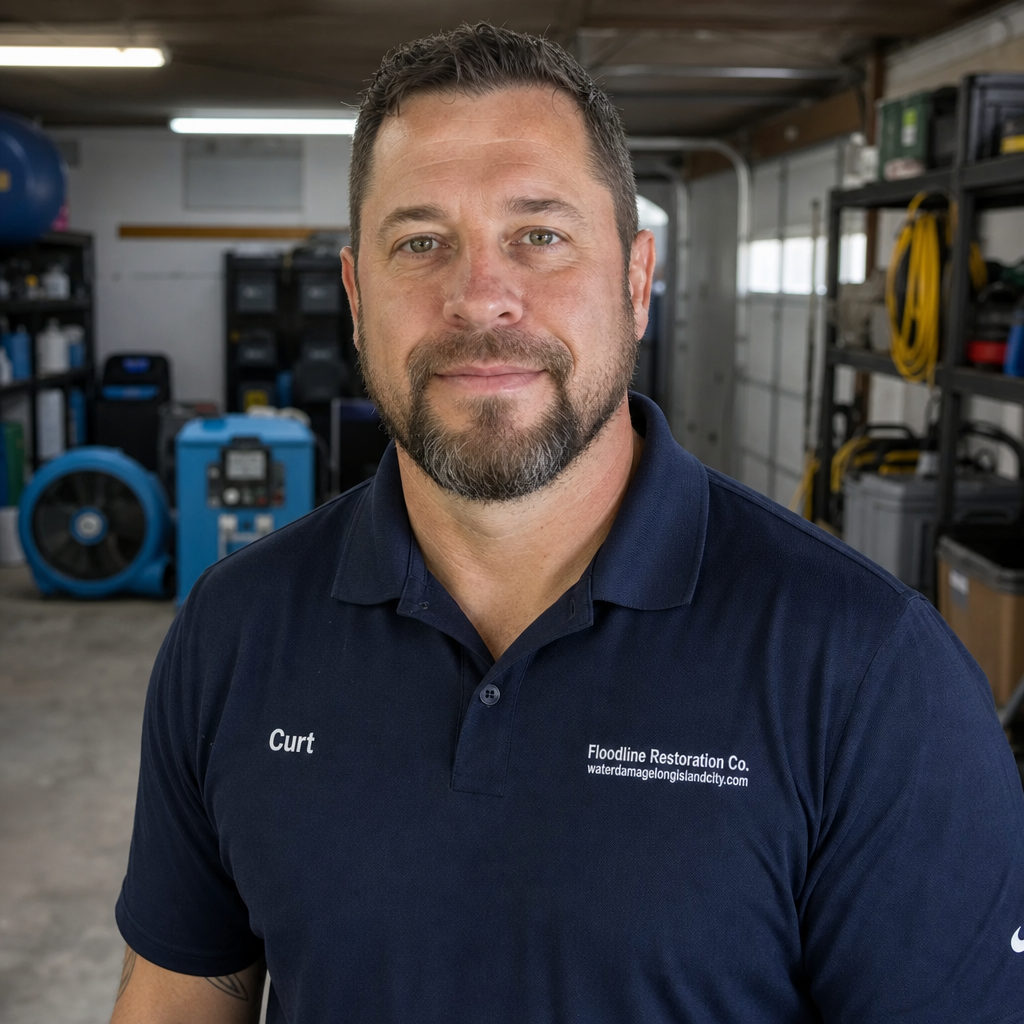
Curt Bowman leads our Long Island City team. He has spent his career in this trade, and when the company decided to plant a flag in this part of the city, Curt was the one who built the crew, learned the buildings, and set the pace. He knows which buildings in Long Island City have cast-iron risers that snap without warning. He knows what a nor’easter does to basements in Ditmars Steinway versus the high-rises in Midtown West. That kind of knowledge is not taught in a classroom. It is earned over years of pulling wet drywall and documenting damage for adjusters who need the truth, not a sales pitch.
The promise from day one was simple: we would show up, we would start the same day, and we would stand behind the work. No exceptions for bad weather. No exceptions for weekends. The phone rings, a person answers, and the crew gets moving.
Curt Bowman’s Personal Connection to the Damage Restoration Trade
Curt Bowman got into this work because he saw what happens to a house when no one treats the first hour with urgency. Early in his career, as a young tradesman, he was sent to a home in Queens where a supply line had failed on the second floor. By the time anyone called a professional, the water had been running for most of a day. The ceiling in the living room had given way. The plaster was sagging in sheets. The smell was not just damp. It was the smell of a house starting to rot from the inside.
That job stayed with him. Not because it was complicated, but because it did not have to be that bad. Ten minutes with a shutoff valve and a wet vac early that morning would have saved that family weeks of displacement and tens of thousands in reconstruction. The damage was not the result of bad luck. It was the result of delayed action. Curt decided then that his work would be built around one truth: speed is not a luxury in this business. It is the entire job.
He trained under tradesmen who taught restoration the old way. You do not rush the dry-out, but you do not wait to start it. You read the moisture meter the way a doctor reads a chart. You document everything, because the insurance carrier will ask, and the homeowner deserves an honest record of what happened. You treat the house like it belongs to someone who loves it. Because it does.
There is a particular satisfaction in the later stages of a big job. The day the fans come out. The day the trim goes back on and the paint is dry and the house smells like fresh wood instead of standing water. Curt has been part of hundreds of those days across the city. He says that is the real reason he stays in this trade. Not the emergencies, though he is good in an emergency. It is the handoff at the end. The moment when a family walks back into their own home and realizes it looks, smells, and feels like home again.
If he were not doing this work, Curt would likely still be working with his hands somewhere, probably in an old building, probably fixing something that everyone else said should be torn down. He is drawn to salvage. To the idea that a structure is worth saving when someone is willing to do the job properly instead of cutting corners and walking away. That is what gets him out of bed at six in the morning. The knowledge that somewhere in Queens or Manhattan, there is a homeowner staring at a soaked floor who needs someone to answer the phone and mean it.
Meet Curt Bowman - The Person Behind Every Job
Curt Bowman is the Owner and Founder of Floodline Restoration Co.’s Long Island City branch. He has spent his entire working life in the damage restoration and reconstruction trades, with experience that spans every phase of the work: emergency water extraction, structural drying, mold remediation, fire and smoke recovery, and full rebuilds. He is state-licensed and carries the insurance and bonding a homeowner should expect from anyone entering their home.
What separates Curt from a technician at a corporate franchise is continuity. When you call this office, you are calling a local team that answers to a local owner. Curt knows the buildings in this part of the city. He knows how water moves through a prewar walk-up in Astoria versus a modern tower in Midtown East. He knows the adjusters, the building supers, and the quirks of the local codes. That knowledge means the job gets scoped correctly the first time, not discovered in pieces three weeks later.
Outside the office, Curt is a student of old construction methods. He reads about plaster work and timber framing and the way buildings were built a hundred years ago, because understanding why a building is standing helps him understand why it is failing. He brings that same curiosity to every job in Long Island City. His commitment is personal. If his name is on the work, it is done right, or it is not done.
Our Promise to Long Island City Homeowners
Our promise starts with a square deal on the bill. We put the scope of work in writing before we start. You will know what we are going to do, why it needs to be done, and what it will cost. No surprises when the invoice arrives.
We also promise to work in your house the way we would work in our mother’s house. That means floor protection. That means clean job sites. That means explaining things in plain English instead of trade jargon. And it means never recommending a service you do not actually need.
Above all, we stand behind the work. The Keystone Standard is our guarantee, in writing: 90 days, no arguing. If something is not right, we come back and fix it. That has been the rule since Floodline Restoration Co. opened its doors in 2010, and it is the rule at our Long Island City branch today.
Our Credentials
- State-licensed - every professional working under the Floodline Restoration Co. name in New York is required to hold the license their trade demands.
- Insured and bonded - we carry coverage that protects your home and our team while we work in it, and we are happy to provide documentation to your carrier.
- Long local track record - our brand has been restoring homes since 2010, and our Long Island City team has deep roots in the neighborhoods we serve.
- Direct insurance billing - we bill your carrier directly and coordinate with adjusters, so you are never stuck playing messenger between your insurance company and your contractor.
- Photo-documented assessments - every job gets a documented moisture map and daily readings until the dry standard is met, with the log provided to you and your carrier.
Here is why these credentials matter. A license means the person in your home has proven they know the codes and the craft. Insurance means if something goes wrong on the job site, you are not left holding the bag. Direct billing means you do not have to front thousands of dollars and wait months to be reimbursed. Documentation means your adjuster sees exactly what we saw, which keeps the claim honest and moving.
Rooted in Long Island City
Long Island City is not just a service area on our route sheet. It is where our trucks start every morning. We know the blocks between Queens Plaza and Hunters Point, the converted factories turned condos, the new towers on the waterfront, and the old row houses that have been standing since before the subway lines were built. We work in Greenpoint and Williamsburg, Astoria and Maspeth, Murray Hill and Midtown, Washington Square and the Upper East Side. When the water rises, we know exactly how long it takes to get to you, and we know the buildings well enough to start solving the problem before we arrive.
Written by Curt Bowman, Owner at Floodline Restoration Co., serving Long Island City since the branch opened. Call (716) 452-0798 for help with water, fire, or mold damage restoration anytime, day or night.